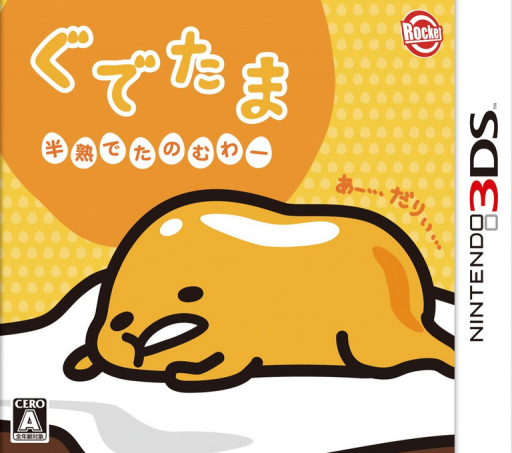
Gudetama - Hanjuku de Tanomuwa
Gudetama - Hanjuku de Tanomuwa is a Nintendo 3DS simulation game released in 2015. It centers on state management, system learning, and repeated adjustment and feedback, using the dual screens, touch input, physical controls, and stereoscopic display where the design calls for them.
- AI score · out of 10
- 6.7 / 10
About this game
Gudetama - Hanjuku de Tanomuwa is a Nintendo 3DS simulation game centered on state management, system learning, and repeated adjustment and feedback. In this Nintendo 3DS release, state management, system learning, and repeated adjustment and feedback form the main playable structure. Schedules, changing values, or staged goals encourage repeated adjustment. The dual screens, stylus, buttons, Circle Pad, and stereoscopic display divide commands from status information where appropriate. Art, animation, sound, interface clarity, and spatial readability are judged against 3DS-era conditions, while explanations, dense menus, real-time systems, or accessory dependencies can add friction. This description applies to the Nintendo 3DS edition and does not import modes, presentation upgrades, or convenience features from home-console versions, mobile adaptations, later ports, or remakes.
Collected in series
Gudetama games turn Sanrio’s lethargic egg into a source of food jokes, collecting and small challenges. Depending on the game, you gather ingredients, cook, help a restaurant or recruit Gudetama characters for an RPG adventure. Their unhurried personality ties these different activities together.
Recommended games
Related game recommendations on this platform
Nintendo 3DS


AI review
AI reviews are subjective assessments, not player ratings. See each review for its evidence and limitations.Published date:
基本成立 Nintendo 3DS simulation experience
Gudetama - Hanjuku de Tanomuwa centers on state management, system learning, and repeated adjustment and feedback. Schedules, changing values, or staged goals encourage repeated adjustment, giving the 3DS release recognizable goals and a coherent portable rhythm. Dual screens, touch input, physical controls, and stereoscopic presentation support information and spatial judgment where applicable. The main limitation is that explanations, dense menus, real-time systems, or accessory dependencies can add friction. Replay value depends on how well its rules, content variety, and learning curve continue to reward mastery. GameNavo scores this concrete release across four independently judged dimensions and excludes press aggregates, user ratings, source length, media count, and title recognition. Any small platform-merit adjustment is tied to documented hardware use or version execution.
Strengths
- state management, and system learning provide a readable mechanical foundation.
- Progress is divided into understandable stages, tasks, matches, or chapters.
- Dual-screen, interface, and audiovisual feedback support the main rules.
Weaknesses
- Explanations, dense menus, real-time systems, or accessory dependencies can add friction.
- Original online services, language, accessories, or stereoscopic conditions may affect present-day use.
Who it is for: Players who enjoy simulation games, accept Nintendo 3DS interface conventions, and want to assess the original handheld release on its own terms.
Play notes: This review covers the Nintendo 3DS release without emulator conveniences or features from other platforms and does not represent a complete playthrough.
View scoring basis
| Dimension | Review state | Score | Weight |
|---|---|---|---|
| Dimension Schedules, changing values, or staged goals encourage repeated adjustment. The 6.7 score weighs variety, repetition, difficulty progression, recovery, and replay value. | Reviewed | 6.7 / 10 | Not provided |
| Dimension The core loop is assessed through state management, system learning, and repeated adjustment and feedback, including rule depth, control feedback, and room for mastery. This 3DS release earns 6.6. | Reviewed | 6.6 / 10 | Not provided |
| Dimension The 7.1 score judges art, sound, interface, dual-screen use, and stereoscopic spatial readability against 3DS-era conditions. | Reviewed | 7.1 / 10 | Not provided |
| Dimension Explanations, dense menus, real-time systems, or accessory dependencies can add friction. The 6.6 score covers original-hardware response, information clarity, saving, language, accessories, and service availability. | Reviewed | 6.6 / 10 | Not provided |
Review sources
Not provided
Core information
- Developer
- Rocket
- Publisher
- Rocket
- Release date
- 2015
- Platforms
- Nintendo 3DS
- Content kind
- Game
- Release state
- Released
- Region
- Worldwide
- Official website
- Not provided
- Offline minimum players
- Not provided
- Offline maximum players
- Not provided
- Online minimum players
- Not provided
- Online maximum players
- Not provided
- Categories
- Simulation · Primary genre
- Tags
- Long-term ProgressionLife SimulationCozyResource ManagementReplayableThird Person3D GraphicsSlow BurnSolo-friendlyMain Story 20–50 Hours
- Supported game languages
- Not provided
- Requires base game
- Not provided
- Standalone
- Not provided
- Age ratings
- Not provided
- Play modes
- Single player
- Perspectives
- Side view
Release editions
- Nintendo 3DSWorldwide2015
Game gallery
Sources
Not provided