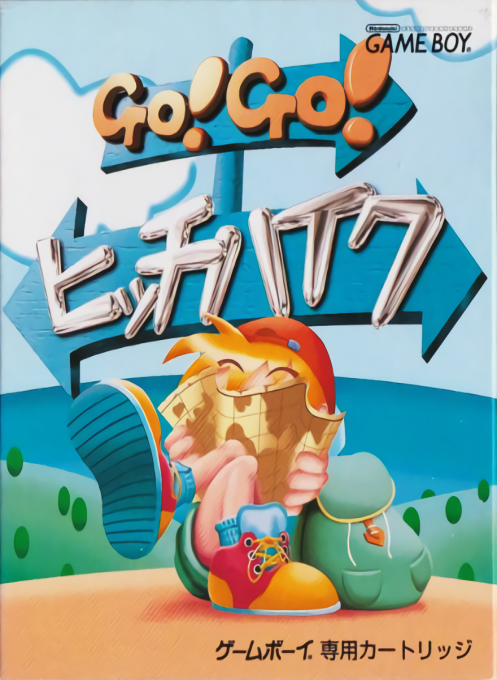
Go! Go! Hitchhike
Go! Go! Hitchhike is a Game Boy card and board game released in 1998 developed by Ocarina System. It centers on rules interaction, board assessment, and turn-by-turn decisions, with controls, information, and pacing arranged around a monochrome small screen, a directional pad, and two main action buttons.
- AI score · out of 10
- 6.5 / 10
About this game
Go! Go! Hitchhike is a Game Boy card and board release centered on rules interaction, board assessment, and turn-by-turn decisions. Matches, decks, or board objectives create a repeatable strategy loop, with progress divided into stages, tasks, matches, or growth milestones that make its immediate goals understandable. Its value depends on whether these rules continue to create judgment and room for mastery rather than on campaign length or series recognition. Short campaigns are judged by repeat-challenge value, while longer ones are judged by variety, pacing, and recovery after failure. Card, board, and state readability determine usability, while silhouettes, contrast, and audio cues need to remain clear on the monochrome display. The main genre-specific friction is that rules terminology, opponent pacing, and text density raise the entry barrier. In addition, password or battery saves, link-cable requirements, display blur, manual dependence, and regional language can affect use of the original cartridge today. This description covers only this release and excludes emulator features, modern-port conveniences, and content from other platforms.
Recommended games
Related game recommendations on this platform
Game Boy (GB)
AI review
AI reviews are subjective assessments, not player ratings. See each review for its evidence and limitations.Published date:
Travel management offers choices, but roulette stalls and deadline anxiety undermine their rewards.
Go! Go! Hitchhike turns a European route into a board game about caring for two travelers. Food, rest, treatment and work accompany rides; walking offers dependable movement at a stamina cost. Route order and cards matter, so this is not strategy-free. Ride success and distance still depend on roulette, however. Repeated stalls delay the reward for planning, while the annual deadline amplifies frustration; both accounts describe progress struggling against the calendar. Landmark images make arrivals tangible. Maps and parameter screens separate routes, conditions and destinations, though the compact sidebar needs attention. Pause, saving and Continue support separate sessions, with map detail and stamp inspection helping preparation. It suits patient planners willing to accept chance disrupting their resource management. Check the route first, verify an old cartridge's backup battery and never switch off while saving.
Strengths
- Routes, cards and personal needs create real decisions beyond spinning roulette.
- City landmarks and grouped parameter screens give travel rewards and management information a concrete identity.
- Saving, Continue, map detail and stamp inspection support planning across separate sessions.
Weaknesses
- Failed rides and small advances delay planning rewards; the annual deadline magnifies stalled progress.
- Several tightly arranged map-side values require attention to their individual meanings.
Who it is for: Board-game players who enjoy advance route planning and travel-resource management, can tolerate random setbacks, and do not expect every considered decision to pay off immediately.
Play notes: This covers the original Japanese GB release from 1998. Use the D-pad to select, A to confirm, B to return and Start to pause. Inspect the map before planning, check an old cartridge's backup battery and never switch off during saving.
View scoring basis
| Dimension | Review state | Score | Weight |
|---|---|---|---|
| Dimension Stamps, city arrivals and local race targets give progress a clear direction, with routes and cards supporting completion. Repeated failed rides and events consume the annual limit, however, and both accounts describe progress falling behind available time. Destination rewards remain, but significant stalling and anxiety make pacing weak, without treating one run's difficulty as universal. | Reviewed | 5.5 / 10 | Not provided |
| Dimension Routes, walking costs, needs and cards establish real decisions, making the core basically workable. Yet ride success and distance depend on roulette, so even a considered plan can repeatedly stall, weakening the connection between choice and result. This is not strategy-free, but random resistance often overshadows the satisfaction of active decisions, placing it in the band with substantial shortcomings. | Reviewed | 6.4 / 10 | Not provided |
| Dimension City landmarks and separated dialogue give travel a recognizable arrival reward. Routes, parameter icons and the next destination have distinct areas, making presentation good overall. The compact map sidebar needs careful reading across several values; the strength lies in organizing travel scenes and personal conditions rather than merely displaying roulette results. | Reviewed | 7.1 / 10 | Not provided |
| Dimension Directional selection, A confirmation, B return and direct pause serve the menu-based game. Map detail and stamp inspection provide practical planning tools, while saving and Continue allow a journey across separate sessions, yielding good usability. Players should learn the return path between command pages, check an old cartridge's backup battery and avoid switching off during saving. | Reviewed | 7.7 / 10 | Not provided |
Review sources
Not provided
Core information
- Developer
- Ocarina System
- Publisher
- J-Wing
- Release date
- 1998
- Platforms
- Game Boy (GB)
- Content kind
- Game
- Release state
- Released
- Region
- Worldwide
- Official website
- Not provided
- Offline minimum players
- Not provided
- Offline maximum players
- Not provided
- Online minimum players
- Not provided
- Online maximum players
- Not provided
- Categories
- Card & Tabletop · Primary genre
- Tags
- 2D GraphicsSlow BurnSolo-friendlyTurn-based TacticsCard PlayBoard and Tabletop Play
- Supported game languages
- Not provided
- Requires base game
- Not provided
- Standalone
- Not provided
- Age ratings
- Not provided
- Play modes
- Single player
- Perspectives
- Not provided
Release editions
- Game Boy (GB)Worldwide1998
Game gallery
Sources
Not provided