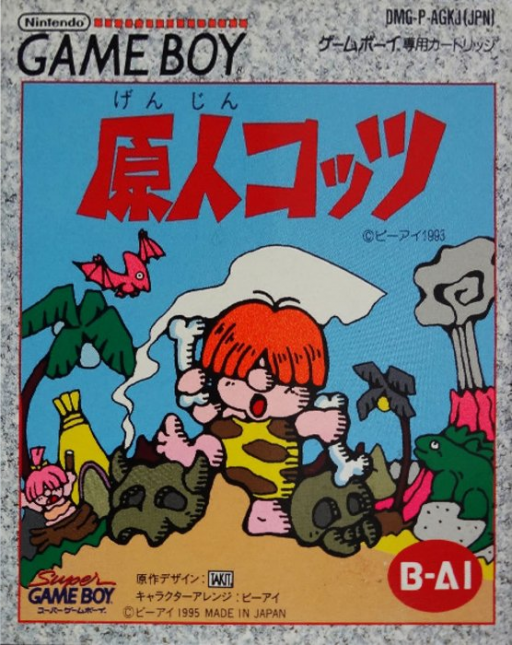
Genjin Cottsu
Genjin Cottsu is a Game Boy action game released in 1995 developed by Kindle Imagine Develop. It centers on movement and immediate actions, enemy and hazard responses, and stage objectives, with controls, information, and pacing arranged around a monochrome small screen, a directional pad, and two main action buttons.
- AI score · out of 10
- 6.7 / 10
About this game
Genjin Cottsu is a Game Boy action release centered on movement and immediate actions, enemy and hazard responses, and stage objectives. Stages build pressure through routes, enemy patterns, and changing objectives, with progress divided into stages, tasks, matches, or growth milestones that make its immediate goals understandable. Its value depends on whether these rules continue to create judgment and room for mastery rather than on campaign length or series recognition. Short campaigns are judged by repeat-challenge value, while longer ones are judged by variety, pacing, and recovery after failure. Readable animation, hits, and hazards determine whether feedback remains dependable, while silhouettes, contrast, and audio cues need to remain clear on the monochrome display. The main genre-specific friction is that period-specific collision rules, limited guidance, and repeated ground after failure can raise the entry barrier. In addition, password or battery saves, link-cable requirements, display blur, manual dependence, and regional language can affect use of the original cartridge today. This description covers only this release and excludes emulator features, modern-port conveniences, and content from other platforms.
Recommended games
Related game recommendations on this platform
Game Boy (GB)
AI review
AI reviews are subjective assessments, not player ratings. See each review for its evidence and limitations.Published date:
Short action stages and rhythm memory reward preparation.
Genjin Kotts joins note collecting, platforming and rhythm memory in a single adventure. Notes are more than points: they pay for ranged attacks, while a club strengthens close combat, linking route choices to available resources. Short action stages alternate with rhythm contests. Percussion, stage events and performances reflecting collected notes give the toy adaptation a coherent musical identity. Unprotected contact allows little room for error, however, and later rhythm tests demand substantially more memory and concentration than jumping alone. A separate practice mode offers six speed levels and an alternative input, encouraging preparation before the main run. Pausing and two stage-level continues soften failure without allowing endless recovery. It suits players who enjoy both compact platforming and learning patterns, rather than those seeking uninterrupted action without practicing the rhythm sections.
Strengths
- Notes connect collection, attacks and resulting performances.
- Short stages, percussion and events establish musical character.
- Adjustable independent rhythm practice and alternative input aid preparation.
Weaknesses
- Limited contact tolerance, later memory demands and finite continues raise recovery costs.
Who it is for: Players who enjoy compact platforming and practicing rhythm or memory patterns.
Play notes: Original Japanese GB software; preserve the two stage continues. The manual's two-player selection is Super Game Boy only.
View scoring basis
| Dimension | Review state | Score | Weight |
|---|---|---|---|
| Dimension Short platforming sections alternate with rhythm tests, but the later memory demand is a substantial change of emphasis that rewards preparation. | Reviewed | 6.8 / 10 | Not provided |
| Dimension Collecting notes and choosing between close-range attacks and costly projectiles connect risk to useful resources, though unprotected contact leaves little room for error. | Reviewed | 6.6 / 10 | Not provided |
| Dimension Percussion, stage events and collection-linked performances give the musical premise a coherent identity without requiring orchestral variety. | Reviewed | 7.2 / 10 | Not provided |
| Dimension Defined controls and adjustable independent rhythm practice support learning, while the finite stage-level continues limit recovery from repeated failures. | Reviewed | 6.4 / 10 | Not provided |
Review sources
Not provided
Core information
- Developer
- Kindle Imagine Develop
- Publisher
- B-AI
- Release date
- 1995
- Platforms
- Game Boy (GB)
- Content kind
- Game
- Release state
- Released
- Region
- Worldwide
- Official website
- Not provided
- Offline minimum players
- Not provided
- Offline maximum players
- Not provided
- Online minimum players
- Not provided
- Online maximum players
- Not provided
- Categories
- Action · Primary genre
- Tags
- PlatformingSolo-friendlyDodgeReal-time Combat2D GraphicsSide-scrollingReplayableFast-pacedMain Story Under 10 HoursLinear Levels
- Supported game languages
- Not provided
- Requires base game
- Not provided
- Standalone
- Not provided
- Age ratings
- Not provided
- Play modes
- Not provided
- Perspectives
- Not provided
Release editions
- Game Boy (GB)Worldwide1995
Game gallery
Sources
Not provided