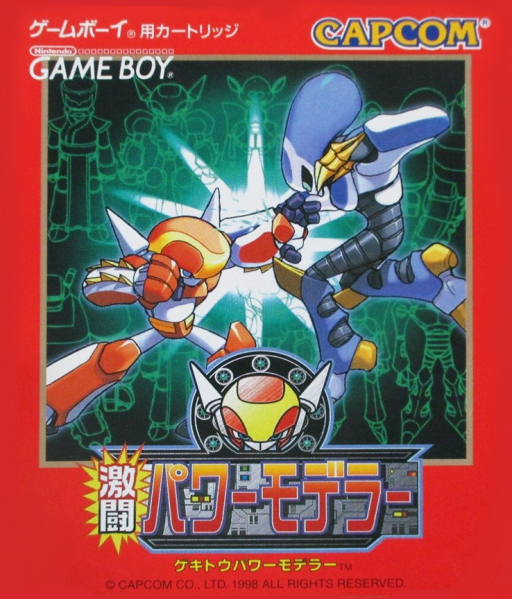
Gekitou Power Modeller
Gekitou Power Modeller is a Game Boy fighting game released in 1998 developed by Japan System Supply. It centers on move inputs, offense-defense reads, and character matchups, with controls, information, and pacing arranged around a monochrome small screen, a directional pad, and two main action buttons.
- AI score · out of 10
- 6.6 / 10
About this game
Gekitou Power Modeller is a Game Boy fighting release centered on move inputs, offense-defense reads, and character matchups. Short bouts use character differences and rising difficulty for variety, with progress divided into stages, tasks, matches, or growth milestones that make its immediate goals understandable. Its value depends on whether these rules continue to create judgment and room for mastery rather than on campaign length or series recognition. Short campaigns are judged by repeat-challenge value, while longer ones are judged by variety, pacing, and recovery after failure. Animation, hit feedback, and readable arenas create match tension, while silhouettes, contrast, and audio cues need to remain clear on the monochrome display. The main genre-specific friction is that button mapping, move recognition, and cpu behavior can affect match balance. In addition, password or battery saves, link-cable requirements, display blur, manual dependence, and regional language can affect use of the original cartridge today. This description covers only this release and excludes emulator features, modern-port conveniences, and content from other platforms.
Recommended games
Related game recommendations on this platform
Game Boy (GB)
AI review
AI reviews are subjective assessments, not player ratings. See each review for its evidence and limitations.Published date:
An inventive pocket robot-fighter hybrid held back by money grinding and a thin story.
Gekitou Power Modeler is the original 1998 Japanese Game Boy cartridge, not the later colour-localised Power Quest. It places one-on-one remote-control robot fights inside a light adventure. Players find challengers around town, win money, purchase parts and choose a model suited to the next match. That structure gives a simple fighter more direction than an isolated arcade ladder, and differing robots and moves invite experimentation. Battle animation and energetic music carry more personality than the spare tournament story. Progress is less elegant: low-paying repeat fights can make the next upgrade feel like a chore, while dialogue does little to distinguish each opponent. Its limited-button combat is clever for a pocket format but should not be mistaken for the depth of a specialist competitive fighter. Nor should praise of the later Game Boy Color palette be transferred to this monochrome release. The Japanese menus and story present a language barrier for some players; available textual sources also do not establish an exact frame rate or input-latency result on original hardware. Retro action-RPG enthusiasts may appreciate its combination of building and battling. Players who dislike grinding through rematches have a clear reason to hesitate.
Strengths
- Robot combat linked to meaningful part upgrades
- Model and move choices encourage experimentation
- Energetic battle animation and music
Weaknesses
- Low-yield fights create grinding
- Light story and repetitive dialogue
- Japanese-only original edition
Who it is for: Retro handheld fans who enjoy fighting mixed with light RPG progression.
Play notes: This is the monochrome Japanese Game Boy original; Power Quest colour graphics and English text belong to a later release.
View scoring basis
| Dimension | Review state | Score | Weight |
|---|---|---|---|
| Dimension A clear tournament goal is slowed by low-yield rematches and a thin story. | Reviewed | 5.7 / 10 | Not provided |
| Dimension Robot duels gain purpose from model swapping and upgrades, though their move set is modest by dedicated fighter standards. | Reviewed | 7.1 / 10 | Not provided |
| Dimension Robot animation and lively music define the monochrome edition; later colour improvements are not credited to it. | Reviewed | 6.7 / 10 | Not provided |
| Dimension The Japanese Game Boy edition is verified, but source text does not justify a specific hardware-performance claim. | Reviewed | 6.5 / 10 | Not provided |
Review sources
Not provided
Core information
- Developer
- Japan System Supply
- Publisher
- CAPCOM
- Release date
- 1998
- Platforms
- Game Boy (GB)
- Content kind
- Game
- Release state
- Released
- Region
- Worldwide
- Official website
- Not provided
- Offline minimum players
- Not provided
- Offline maximum players
- Not provided
- Online minimum players
- Not provided
- Online maximum players
- Not provided
- Categories
- Fighting · Primary genreRole-Playing
- Tags
- Fast-pacedReplayableShort Sessions2D GraphicsCombosPlayer versus PlayerSolo-friendlyReal-time CombatMain Story Under 10 HoursMelee Combat
- Supported game languages
- Not provided
- Requires base game
- Not provided
- Standalone
- Not provided
- Age ratings
- Not provided
- Play modes
- Single player
- Perspectives
- Not provided
Release editions
- Game Boy (GB)Worldwide1998
Game gallery
Sources
Not provided