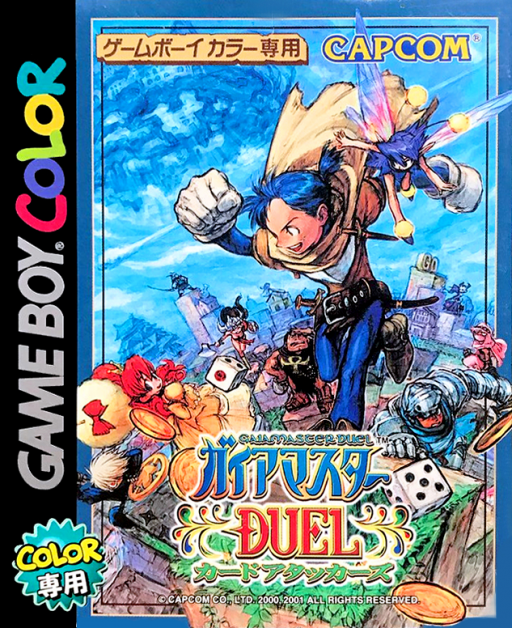
Gaiamaster Duel - Card Attackers
Gaiamaster Duel - Card Attackers is a Game Boy Color strategy game released in 2001 developed by CAPCOM CO., LTD.. It centers on battlefield assessment, unit or resource management, and turn or phase decisions, with controls, information, and pacing arranged around a color handheld screen, a directional pad, and two main action buttons.
- AI score · out of 10
- 6.8 / 10
About this game
Gaiamaster Duel - Card Attackers is a Game Boy Color strategy release centered on battlefield assessment, unit or resource management, and turn or phase decisions. Missions add map constraints, new rules, and tougher opposition, with progress divided into stages, tasks, matches, or growth milestones that make its immediate goals understandable. Its value depends on whether these rules continue to create judgment and room for mastery rather than on campaign length or series recognition. Short campaigns are judged by repeat-challenge value, while longer ones are judged by variety, pacing, and recovery after failure. Maps, unit states, and action feedback determine whether complex situations remain readable, while color choices need to distinguish characters, objects, and routes rather than serve as decoration alone. The main genre-specific friction is that brief tutorials, dense menus, and long scenarios increase the learning curve. In addition, battery saves, link cables, cartridge-specific hardware, the unlit display, and regional language can affect the original experience. This description covers only this release and excludes emulator features, modern-port conveniences, and content from other platforms.
Recommended games
Related game recommendations on this platform
Game Boy Color (GBC)
AI review
AI reviews are subjective assessments, not player ratings. See each review for its evidence and limitations.Published date:
Property choices and collecting appeal, but healing cards undermine story battles.
Gaiamaster Duel connects property management to brief card battles. Event cards alter movement and land values, while preparation funds and character abilities provide decisions beyond waiting for dice. Revising decks, completing a catalog and unlocking characters give story progression appealing goals. However, abilities activate randomly, and story opponents respond poorly to items: healing cards can drain battles of pressure, making repeated encounters less compelling than collecting. Distinct board colors, opposing portraits and cards, separate HP readouts and asset columns organize information clearly, with fantasy ornament adding personality. Actions and data are gathered in the board menu, and manual predice saves allow reloading. Repeatedly restarting for a preferred roll reduces the pleasure of risk. It suits relaxed collectors and property planners more than players seeking consistently demanding solo tactical opposition.
Strengths
- Event cards, preparation funds and character abilities add property choices beyond dice rolls.
- Deck revision, catalog completion and hidden characters connect longer-term rewards.
- Observed boards, opposing HP and asset columns have clear static information layers.
- A concentrated action menu and explicit manual saving support separate play sessions.
Weaknesses
- Story opponents respond poorly to healing cards, allowing suitable decks to suppress opposition.
- Card battles become monotonous, with encounters less durable than collecting rewards.
- Character abilities cannot be activated deliberately, making combinations depend on randomness.
Who it is for: Property-game and card collectors who enjoy revising decks and trying characters, and value collecting goals more than persistently demanding solo opposition.
Play notes: This covers the Japanese original GBC Duel game, with solo judgments centered on story mode rather than human competitive balance. Manual predice saves can be reloaded; avoid repeated restarts for preferred rolls if you want to preserve random risk.
View scoring basis
| Dimension | Review state | Score | Weight |
|---|---|---|---|
| Dimension Deck revision, catalog completion and hidden characters give story progression meaningful rewards, with stages providing intermediate goals. Battles can nevertheless lose variety, leaving collecting more durable than the opposition encountered along the way. Content is reasonably substantial, but repeated combat constrains its pacing. | Reviewed | 6.7 / 10 | Not provided |
| Dimension Event cards, land values, preparation funds and character abilities connect property management to planned card battles rather than mere dice waiting. Random abilities and weak CPU item responses limit strategic exchanges in story mode, especially when healing cards suppress the challenge. The system works, but sustained opposition lacks depth. | Reviewed | 6.4 / 10 | Not provided |
| Dimension Observed board, duel and result screens organize information with distinct colors, portraits and borders. Fantasy characters and shield motifs give the property-card game personality, while objectives, opposing HP and asset comparisons are clearly layered. Its demonstrated strengths are static style and readable information organization. | Reviewed | 7.3 / 10 | Not provided |
| Dimension A concentrated action menu, data and catalog access, and explicit manual save/reload support good basic usability without divorcing property information from the board. Predice reloading changes random outcomes, so preserving the intended risk calls for restraint. These conveniences do not imply all-state recovery or present-day cartridge reliability. | Reviewed | 7.6 / 10 | Not provided |
Review sources
Not provided
Core information
- Developer
- CAPCOM
- Publisher
- CAPCOM
- Release date
- 2001
- Platforms
- Game Boy Color (GBC)
- Content kind
- Game
- Release state
- Released
- Region
- Worldwide
- Official website
- Not provided
- Offline minimum players
- Not provided
- Offline maximum players
- Not provided
- Online minimum players
- Not provided
- Online maximum players
- Not provided
- Categories
- Strategy & Tactics · Primary genre
- Tags
- Command-based Combat2D GraphicsSlow BurnLong-term ProgressionSolo-friendlyMain Story 20–50 HoursTop-downReplayableResource ManagementTurn-based Tactics
- Supported game languages
- Not provided
- Requires base game
- Not provided
- Standalone
- Not provided
- Age ratings
- Not provided
- Play modes
- Not provided
- Perspectives
- Not provided
Release editions
- Game Boy Color (GBC)Worldwide2001
Game gallery
Sources
Not provided