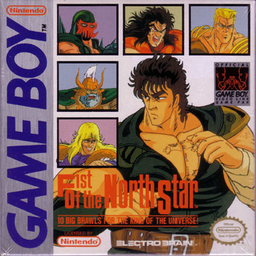
Fist of the North Star
Fist of the North Star is a Game Boy fighting game released in 1989 developed by Shouei System. It centers on move inputs, offense-defense reads, and character matchups, with controls, information, and pacing arranged around a monochrome small screen, a directional pad, and two main action buttons.
- AI score · out of 10
- 5.1 / 10
About this game
Fist of the North Star is a Game Boy fighting release centered on move inputs, offense-defense reads, and character matchups. Short bouts use character differences and rising difficulty for variety, with progress divided into stages, tasks, matches, or growth milestones that make its immediate goals understandable. Its value depends on whether these rules continue to create judgment and room for mastery rather than on campaign length or series recognition. Short campaigns are judged by repeat-challenge value, while longer ones are judged by variety, pacing, and recovery after failure. Animation, hit feedback, and readable arenas create match tension, while silhouettes, contrast, and audio cues need to remain clear on the monochrome display. The main genre-specific friction is that button mapping, move recognition, and cpu behavior can affect match balance. In addition, password or battery saves, link-cable requirements, display blur, manual dependence, and regional language can affect use of the original cartridge today. This description covers only this release and excludes emulator features, modern-port conveniences, and content from other platforms.
Recommended games
Related game recommendations on this platform
Game Boy (GB)
AI review
AI reviews are subjective assessments, not player ratings. See each review for its evidence and limitations.Published date:
Character growth offers interest, but one tactic overwhelms fighting depth
Game Boy Fist of the North Star centers on consecutive duels between eleven fighters. Normal-mode victories award experience and increase attack and defense, with trained characters usable in versus or team play. This continuity provides short sessions with an accumulating goal, and recognizable figures retain a connection to the source. Most differences nevertheless concern reach and charged projectiles rather than varied close combat. Repeatedly retreating and firing multiple shots leaves the computer unable to respond effectively, turning training into a dominant routine. Heavy characters cannot jump or crouch, but their differences do not create richer exchanges. Sometimes catchy music, sparse backgrounds and ordinary strike effects add limited variety. Passwords make growth resumable, yet character quantity cannot disguise the shallow competitive system.
Strengths
- Experience growth carries into versus and team modes, giving repeated sessions continuity
- Recognizable characters and passwords make the lightweight adaptation easy to revisit
Weaknesses
- Repeated retreating projectile attacks dominate AI, narrowing tactical choices
- Limited combat, scenery and music variation make training repetitive
Who it is for: Fans interested in the characters or early handheld fighting who accept shallow exchanges and repeated growth-oriented bouts.
Play notes: Original GB release, not the NES action game. A/B actions and mobility depend on the fighter; Heart and Uygur cannot jump or crouch. Record growth passwords, and expect weak computer defenses against repeated multi-projectile attacks.
View scoring basis
| Dimension | Review state | Score | Weight |
|---|---|---|---|
| Dimension Growth carries into versus and team modes, lending continuity, but limited duel variation makes extended training repetitive. | Reviewed | 5.2 / 10 | Not provided |
| Dimension Range, charged shots and heavy-character mobility create some differences, but retreating projectile repetition overwhelms AI and replaces meaningful adaptation. | Reviewed | 4.4 / 10 | Not provided |
| Dimension Recognizable figures and sometimes catchy tunes retain the license, but sparse backgrounds, similar music and ordinary effects limit expressive variety. | Reviewed | 5.9 / 10 | Not provided |
| Dimension Few buttons and passwords ease learning and resumption, but heavy fighters cannot jump or crouch, so selection requires understanding differing movement. | Reviewed | 6.0 / 10 | Not provided |
Review sources
Not provided
Core information
- Developer
- Shouei
- Publisher
- Taxan
- Release date
- 1989
- Platforms
- Game Boy (GB)
- Content kind
- Game
- Release state
- Released
- Region
- Worldwide
- Official website
- Not provided
- Offline minimum players
- Not provided
- Offline maximum players
- Not provided
- Online minimum players
- Not provided
- Online maximum players
- Not provided
- Categories
- Fighting · Primary genre
- Tags
- Short SessionsCombosMelee CombatReal-time CombatFast-paced2D Graphics
- Supported game languages
- Not provided
- Requires base game
- Not provided
- Standalone
- Not provided
- Age ratings
- Not provided
- Play modes
- Not provided
- Perspectives
- Not provided
Release editions
- Game Boy (GB)Worldwide1989
Game gallery
Sources
Not provided