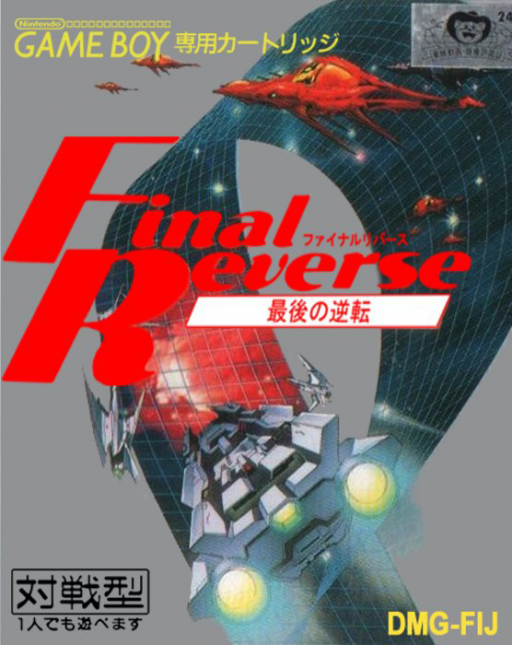
Final Reverse
Final Reverse is a Game Boy shooter game released in 1991 developed by Shouei System. It centers on shooting and weapon management, positioning and evasion, and enemy and route judgment, with controls, information, and pacing arranged around a monochrome small screen, a directional pad, and two main action buttons.
- AI score · out of 10
- 5.9 / 10
About this game
Final Reverse is a Game Boy shooter release centered on shooting and weapon management, positioning and evasion, and enemy and route judgment. Missions pace progress through enemy waves, routes, and weapon opportunities, with progress divided into stages, tasks, matches, or growth milestones that make its immediate goals understandable. Its value depends on whether these rules continue to create judgment and room for mastery rather than on campaign length or series recognition. Short campaigns are judged by repeat-challenge value, while longer ones are judged by variety, pacing, and recovery after failure. Projectiles, hits, and danger zones must remain readable within the available display, while silhouettes, contrast, and audio cues need to remain clear on the monochrome display. The main genre-specific friction is that dense encounters, limited visibility, and continue costs amplify reaction and memorization pressure. In addition, password or battery saves, link-cable requirements, display blur, manual dependence, and regional language can affect use of the original cartridge today. This description covers only this release and excludes emulator features, modern-port conveniences, and content from other platforms.
Recommended games
Related game recommendations on this platform
Game Boy (GB)
AI review
AI reviews are subjective assessments, not player ratings. See each review for its evidence and limitations.Published date:
An inventive route exchange undermined by monotonous computer duels.
Final Reverse's interesting idea is to draw a route during a thirty-second preliminary, then constrain the opponent to that route in the final. A reflecting mirror, the side on which power-ups appear and weapon switching add decisions beyond simply firing. Unfortunately, computer opponents struggle with winding tracks even at the highest difficulty, and bomb power-ups can end fights quickly. One reported blocked layout also halted direct exchanges. These problems limit development in solo play. Five-ship contests, single duels and a wider arena offer different commitments, but the expanded space changes little and repeated computer fights become monotonous. Menus, dark tracks and power-up letters communicate the basics, while tiny ship icons do little to explain the nine craft. It is an interesting rules experiment rather than a durable source of escalating solo challenge.
Strengths
- Preparing the opponent's route adds active planning to shooting.
- Reflections and power-up timing offer decisions beyond firing.
- A/B inputs and opening orientation and difficulty options make basic setup manageable.
Weaknesses
- Computer opponents remain easily trapped even at high difficulty.
- The wider arena adds little variety to repetitive solo encounters.
- The nine ships' differing properties are inadequately explained.
Who it is for: Shooting players curious about route exchange and reflected fire who can accept weak computer opposition.
Play notes: This covers the original Japanese GB software. Understand that your preliminary route constrains the opponent before selecting horizontal or vertical duels. Ship properties require experimentation; higher difficulty does not provide strong counterplay. After completion, wait through the credits or reset.
View scoring basis
| Dimension | Review state | Score | Weight |
|---|---|---|---|
| Dimension Five-ship and single-duel formats offer different commitments, but a wider arena retains similar encounters and computer battles become monotonous. The menu's alternatives do not produce enough sustained variety. | Reviewed | 5.4 / 10 | Not provided |
| Dimension Prepared routes, reflected fire and power-ups add meaningful choices to dueling. Easily trapped opponents even at high difficulty fail to sustain resistance, weakening the challenge offered by those rules. | Reviewed | 5.6 / 10 | Not provided |
| Dimension Readable menus, tracks and power-up labels communicate the basic structure. Small ships and absent parameter displays do less to explain the roster, leaving serviceable presentation with limited selection feedback. | Reviewed | 6.4 / 10 | Not provided |
| Dimension Simple A/B inputs and opening options make setup manageable, including orientation and roster order. Poorly explained ship differences and waiting for credits or resetting after completion leave the replay process less convenient. | Reviewed | 6.8 / 10 | Not provided |
Review sources
Not provided
Core information
- Developer
- Shouei
- Publisher
- Toei Animation
- Release date
- 1991
- Platforms
- Game Boy (GB)
- Content kind
- Game
- Release state
- Released
- Region
- Worldwide
- Official website
- Not provided
- Offline minimum players
- Not provided
- Offline maximum players
- Not provided
- Online minimum players
- Not provided
- Online maximum players
- Not provided
- Categories
- Shooter · Primary genre
- Tags
- Replayable2D GraphicsLinear LevelsMain Story Under 10 HoursFast-pacedSide-scrollingDodgePlayer versus EnvironmentSolo-friendlyShooting
- Supported game languages
- Not provided
- Requires base game
- Not provided
- Standalone
- Not provided
- Age ratings
- Not provided
- Play modes
- Not provided
- Perspectives
- Not provided
Release editions
- Game Boy (GB)Worldwide1991
Game gallery
Sources
Not provided