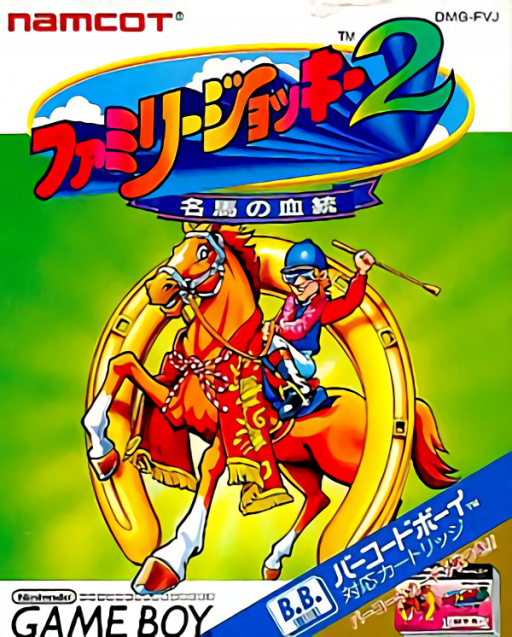
Family Jockey 2 - Meiba no Kettou
Family Jockey 2 - Meiba no Kettou is a Game Boy sports game released in 1993 developed by Use Corporation. It centers on sport controls, shifts between attack and defense, and score or tournament goals, with controls, information, and pacing arranged around a monochrome small screen, a directional pad, and two main action buttons.
- AI score · out of 10
- 6.6 / 10
About this game
Family Jockey 2 - Meiba no Kettou is a Game Boy sports release centered on sport controls, shifts between attack and defense, and score or tournament goals. Matches, challenges, and tournament goals give sessions clear boundaries, with progress divided into stages, tasks, matches, or growth milestones that make its immediate goals understandable. Its value depends on whether these rules continue to create judgment and room for mastery rather than on campaign length or series recognition. Short campaigns are judged by repeat-challenge value, while longer ones are judged by variety, pacing, and recovery after failure. Players, venues, and score feedback establish the match atmosphere, while silhouettes, contrast, and audio cues need to remain clear on the monochrome display. The main genre-specific friction is that opponent ai, control precision, and period-specific rosters can affect consistency. In addition, password or battery saves, link-cable requirements, display blur, manual dependence, and regional language can affect use of the original cartridge today. This description covers only this release and excludes emulator features, modern-port conveniences, and content from other platforms.
Recommended games
Related game recommendations on this platform
Game Boy (GB)
AI review
AI reviews are subjective assessments, not player ratings. See each review for its evidence and limitations.Published date:
Enjoyable stamina planning, with a limited horse-development layer.
Family Jockey 2 connects direct riding with preparation through breeding. Races are not simply about accelerating constantly: collisions waste stamina, and saving energy for a late charge competes with leading early for records. Progressing through race classes toward top-level wins gives repeated attempts direction, while race selection leaves room to choose another target. Horse attributes cannot improve through training, however, and a limited racing career makes management depend more on selection and breeding again. Paid jockey performance also offers little reassurance for delegation. The viewed overhead scene distinguishes track edges, trees, riders and the controlled entrant through simple visual contrast. Barcode Boy adds a source of horses rather than a requirement for basic play. It suits hands-on race management more than long-term training of one favorite horse.
Strengths
- Position and stamina tradeoffs during direct riding
- Race selection and class progression provide goals
- Basic play does not require barcode hardware
Weaknesses
- Fixed attributes restrict horse growth
- Paid jockey performance has limited payoff
Who it is for: Players who enjoy direct riding, stamina planning and experimenting with breeding.
Play notes: Exhaustion is usually difficult to recover from. Barcode Boy supplies additional horses; associated versus racing is automated, not two players directly controlling their mounts.
View scoring basis
| Dimension | Review state | Score | Weight |
|---|---|---|---|
| Dimension Race classes, breeding and top-level wins provide continuing goals and flexible entry choices, but fixed attributes and limited careers encourage repeated selection and reracing. | Reviewed | 6.1 / 10 | Not provided |
| Dimension Direct riding offers meaningful position and stamina tradeoffs; weak hired riding and fixed attributes limit the payoff of the management layer. | Reviewed | 6.8 / 10 | Not provided |
| Dimension The viewed track, trees and small riders form a compact overhead composition, with a player marker aiding orientation; this supports bounded visual recognition, not unheard music or full-motion claims. | Reviewed | 6.5 / 10 | Not provided |
| Dimension Race entry and self-riding/delegation choices have clear uses, and the accessory is optional; exhaustion is difficult to recover from, making rule understanding important. | Reviewed | 6.8 / 10 | Not provided |
Review sources
Not provided
Core information
- Developer
- Use
- Publisher
- Bandai Namco
- Release date
- 1993
- Platforms
- Game Boy (GB)
- Content kind
- Game
- Release state
- Released
- Region
- Worldwide
- Official website
- Not provided
- Offline minimum players
- Not provided
- Offline maximum players
- Not provided
- Online minimum players
- Not provided
- Online maximum players
- Not provided
- Categories
- Sports · Primary genre
- Tags
- Short SessionsSports-based PlayFast-pacedPick-up and PlaySolo-friendly2D Graphics
- Supported game languages
- Not provided
- Requires base game
- Not provided
- Standalone
- Not provided
- Age ratings
- Not provided
- Play modes
- Not provided
- Perspectives
- Not provided
Release editions
- Game Boy (GB)Worldwide1993
Game gallery
Sources
Not provided