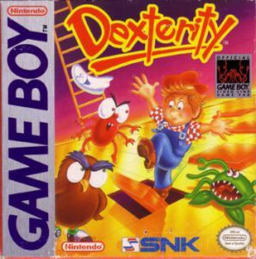
Dexterity
Dexterity is a Game Boy puzzle game released in 1990 developed by SNK. It centers on puzzle, maze, or device solving, rule recognition, and spatial or logical judgment, with controls, information, and pacing arranged around a monochrome small screen, a directional pad, and two main action buttons.
- AI score · out of 10
- 6.6 / 10
About this game
Dexterity is a Game Boy puzzle release centered on puzzle, maze, or device solving, rule recognition, and spatial or logical judgment. Compact stages add conditions and tighter constraints over time, with progress divided into stages, tasks, matches, or growth milestones that make its immediate goals understandable. Its value depends on whether these rules continue to create judgment and room for mastery rather than on campaign length or series recognition. Short campaigns are judged by repeat-challenge value, while longer ones are judged by variety, pacing, and recovery after failure. Graphics, audio cues, and state feedback need to support decisions directly, while silhouettes, contrast, and audio cues need to remain clear on the monochrome display. The main genre-specific friction is that limited explanations, repetition, or abrupt difficulty can stall progress. In addition, password or battery saves, link-cable requirements, display blur, manual dependence, and regional language can affect use of the original cartridge today. This description covers only this release and excludes emulator features, modern-port conveniences, and content from other platforms.
Recommended games
Related game recommendations on this platform
Game Boy (GB)
AI review
AI reviews are subjective assessments, not player ratings. See each review for its evidence and limitations.Published date:
A simple timing contest with limited long-term variety.
Dexterity makes completing a board into a contest over tile colour. You turn light squares dark while enemies undo that work. Using an already flipped tile to complete a line can change several squares and stun opponents, so choosing the right moment matters more than pressing quickly. Movement and block pushing use the directional pad, A flips tiles, and B provides contextual actions such as kicking blocks or carrying stunned enemies. Those options add interest to the plain objective once learned. Difficulty rises and practice helps, but extended play can still make the loop feel narrow. Distinctive character and enemy shapes add personality to the block-based field, while music and effects remain modest. It is best suited to short sessions of reactive puzzle play rather than anyone expecting frequent mechanical changes or elaborate presentation.
Strengths
- Timing and tile-chain tactics
- Practice improves board control
Weaknesses
- Narrow long-term loop
- Plain field and modest audio
Who it is for: Players who enjoy short reactive puzzles and territory control.
Play notes: Contextual B actions need learning; no current hardware benchmark is claimed.
View scoring basis
| Dimension | Review state | Score | Weight |
|---|---|---|---|
| Dimension Practice brings progress, but the narrow loop limits novelty. | Reviewed | 5.6 / 10 | Not provided |
| Dimension Tile flipping and enemy interference create a satisfying timing contest. | Reviewed | 7.2 / 10 | Not provided |
| Dimension Character shapes add charm to a plain board and modest audio. | Reviewed | 5.9 / 10 | Not provided |
| Dimension Few inputs cover the actions, though contextual B uses need learning. | Reviewed | 7.4 / 10 | Not provided |
Review sources
Not provided
Core information
- Developer
- SNK
- Publisher
- SNK
- Release date
- 1990
- Platforms
- Game Boy (GB)
- Content kind
- Game
- Release state
- Released
- Region
- Worldwide
- Official website
- Not provided
- Offline minimum players
- Not provided
- Offline maximum players
- Not provided
- Online minimum players
- Not provided
- Online maximum players
- Not provided
- Categories
- Puzzle · Primary genre
- Tags
- Main Story Under 10 HoursSlow BurnSolo-friendlyLow Entry BarrierReplayableShort SessionsPick-up and PlayFixed CameraPuzzle Solving2D Graphics
- Supported game languages
- Not provided
- Requires base game
- Not provided
- Standalone
- Not provided
- Age ratings
- Not provided
- Play modes
- MultiplayerSingle player
- Perspectives
- Not provided
Release editions
- Game Boy (GB)Worldwide1990
Game gallery
Sources
Not provided