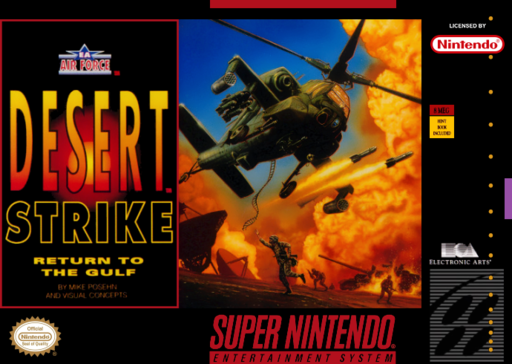
Desert Strike - Return to the Gulf
Desert Strike - Return to the Gulf is a Super Famicom shooter game released in 1992 developed by Electronic Arts. It centers on shooting and weapon use, combat encounters, and collection and development goals, with controls, information, and pacing arranged around television output, a directional pad, shoulder buttons, and a six-button controller.
- AI score · out of 10
- 6.7 / 10
About this game
Desert Strike - Return to the Gulf is a Super Famicom shooter release centered on shooting and weapon use, combat encounters, and collection and development goals. Missions pace progress through enemy waves, routes, and weapon opportunities, with progress divided into stages, tasks, matches, or growth milestones that make its immediate goals understandable. Its value depends on whether these rules continue to create judgment and room for mastery rather than on campaign length or series recognition. Short campaigns are judged by repeat-challenge value, while longer ones are judged by variety, pacing, and recovery after failure. Projectiles, hits, and danger zones must remain readable within the available display, while sprite animation, scrolling, color, and chip-based audio jointly carry readability and atmosphere. The main genre-specific friction is that dense encounters, limited visibility, and continue costs amplify reaction and memorization pressure. In addition, password or battery saves, multiplayer accessories, manual dependence, regional language, and cartridge enhancement chips can affect original-hardware use. This description covers only this release and excludes emulator features, modern-port conveniences, and content from other platforms.
Recommended games
Related game recommendations on this platform
Super Famicom / SNES
AI review
AI reviews are subjective assessments, not player ratings. See each review for its evidence and limitations.Published date:
Mission planning gives this helicopter shooter identity, but SFC targeting and interface friction limit its appeal.
The Super Nintendo conversion of Desert Strike is more than a sequence of targets to destroy. Across four operations, the helicopter attacks facilities and radar sites, rescues people, and manages fuel, ammunition and armour. Hidden supplies and rescue detours make route choice meaningful, while the L/R hover control offers another way to line up a strafing run. This resource-driven structure is the game's strongest distinction from a simpler overhead shooter. Yet direct SFC play accounts describe missiles and the machine gun as less dependable against ground targets than the mission planning deserves. Vehicles and soldiers remain reasonably readable, but the visible play area is narrower and the music conversion less forceful than on some other 16-bit versions. More consequentially, the map and vital resources live behind the Start screen instead of remaining visible during flight. Repeated checks interrupt the action; skipping them can leave the player short of fuel or ammunition at a bad moment. Busy scenes can also slow down. Players who enjoy choosing objectives and managing risk may find an engaging campaign here, provided they tolerate old-fashioned information access and imperfect shooting feedback. This is a judgment of the SFC conversion, not an automatic score for every platform release.
Strengths
- Objective order, rescues and supplies create meaningful choices
- Four operations offer distinct targets and detours
- Vehicles and ground targets remain visually legible
Weaknesses
- Map and critical resources require frequent pauses
- Ground targeting can feel inconsistent and busy scenes slow down
- View size and music lose some force in this conversion
Who it is for: Players who enjoy logistical overhead action and can tolerate frequent map checks.
Play notes: This score covers the Super Nintendo conversion only; other versions need their own assessment.
View scoring basis
| Dimension | Review state | Score | Weight |
|---|---|---|---|
| Dimension Four varied operations sustain interest, but map checks and supply hunting interrupt sorties. | Reviewed | 6.7 / 10 | Not provided |
| Dimension Resource-led strike planning adds depth, while inconsistent ground targeting weakens precision. | Reviewed | 7.1 / 10 | Not provided |
| Dimension Readable vehicles help, though the SFC's view and music have less impact than the earlier version. | Reviewed | 6.8 / 10 | Not provided |
| Dimension Hover-strafing helps, but hidden status information and slowdown create clear SFC friction. | Reviewed | 5.7 / 10 | Not provided |
Review sources
Not provided
Core information
- Developer
- Visual ConceptsElectronic Arts
- Publisher
- Ocean SoftwareElectronic ArtsTec ToyGremlinForesight New MediaAmigaGranite Bay SoftwareBudcat
- Release date
- 1992
- Platforms
- Super Famicom / SNES
- Content kind
- Game
- Release state
- Released
- Region
- Worldwide
- Official website
- Not provided
- Offline minimum players
- Not provided
- Offline maximum players
- Not provided
- Online minimum players
- Not provided
- Online maximum players
- Not provided
- Categories
- Shooter · Primary genre
- Tags
- Solo-friendlySide-scrollingLevel ProgressionPlayer versus Environment2D GraphicsCollection-richReplayableWarLinear LevelsShootingReal-time CombatFast-paced
- Supported game languages
- Not provided
- Requires base game
- Not provided
- Standalone
- Not provided
- Age ratings
- Not provided
- Play modes
- Single player
- Perspectives
- Top-down
Release editions
- Super Famicom / SNESWorldwide1992
Game gallery
Sources
Not provided