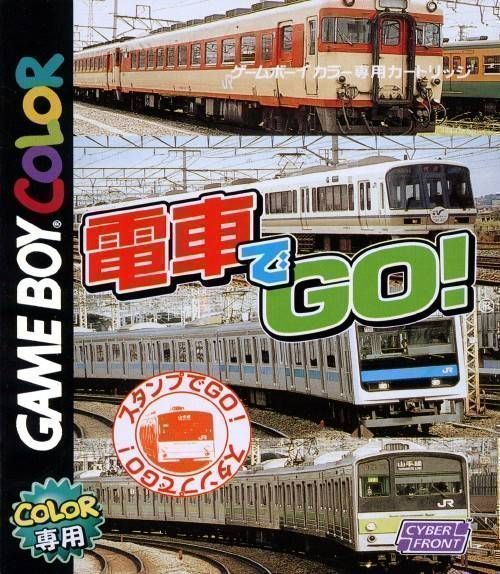
Densha de Go!
Densha de Go! is a Game Boy Color specialized game released in 1999 developed by Taito. It centers on driving and route control, theme-specific rule learning, and button interaction, with controls, information, and pacing arranged around a color handheld screen, a directional pad, and two main action buttons.
- AI score · out of 10
- 6.7 / 10
About this game
Densha de Go! is a Game Boy Color specialized release centered on driving and route control, theme-specific rule learning, and button interaction. Content unfolds through exercises, tasks, or staged objectives, with progress divided into stages, tasks, matches, or growth milestones that make its immediate goals understandable. Its value depends on whether these rules continue to create judgment and room for mastery rather than on campaign length or series recognition. Short campaigns are judged by repeat-challenge value, while longer ones are judged by variety, pacing, and recovery after failure. Interface, theme, and feedback establish the work's identity, while color choices need to distinguish characters, objects, and routes rather than serve as decoration alone. The main genre-specific friction is that an unusual genre fit, explanation style, and language can hinder understanding. In addition, battery saves, link cables, cartridge-specific hardware, the unlit display, and regional language can affect the original experience. This description covers only this release and excludes emulator features, modern-port conveniences, and content from other platforms.
Collected in series
Densha de Go! puts you in the driver's seat on Japanese railway routes. Its train-driving games turn timetables, speed limits and station stops into hands-on challenges, with the satisfaction coming from judging when to accelerate, coast and brake.
Recommended games
Related game recommendations on this platform
Game Boy Color (GBC)
AI review
AI reviews are subjective assessments, not player ratings. See each review for its evidence and limitations.Published date:
Demanding handheld train driving with spare presentation.
The Game Boy Color Densha de Go! compresses timetable driving into a handheld. The D-pad sets throttle, A and B adjust the brakes, and the player watches speed, temporary limits, the clock and the stopping point at each station. Trains need distance to accelerate and slow down, so arriving on time and within the required platform margin demands planning rather than quick reflexes. Two selectable trains and a rail-cart bonus offer small breaks from the central exercise, but the demanding stop-and-schedule pattern remains largely unchanged. A direct GBC account describes sparse scenery outside the cab, simple train sounds and repetitive music. The important instruments remain legible and the controls are workable. Japanese-only text can still hide information from a nonreader. This assessment concerns the reviewed Japanese GBC cartridge; the catalog’s worldwide region is unverified, and features of the later N64 entry are excluded.
Strengths
- Throttle and braking turn each stop into a learned skill.
Weaknesses
- Sparse scenery, repetitive music and a Japanese-language barrier.
Who it is for: Handheld simulation players who enjoy exact stopping.
Play notes: Only the reviewed Japanese GBC cartridge is assessed.
View scoring basis
| Dimension | Review state | Score | Weight |
|---|---|---|---|
| Dimension There is practice depth but limited variety. | Reviewed | 6.7 / 10 | Not provided |
| Dimension Handheld input still conveys anticipatory driving skill. | Reviewed | 7.2 / 10 | Not provided |
| Dimension Information is usable but atmosphere is thin. | Reviewed | 5.5 / 10 | Not provided |
| Dimension Driving works, with a clear language barrier. | Reviewed | 6.8 / 10 | Not provided |
Review sources
Not provided
Core information
- Developer
- Taito
- Publisher
- TaitoCyberFront
- Release date
- 1999
- Platforms
- Game Boy Color (GBC)
- Content kind
- Game
- Release state
- Released
- Region
- Worldwide
- Official website
- Not provided
- Offline minimum players
- Not provided
- Offline maximum players
- Not provided
- Online minimum players
- Not provided
- Online maximum players
- Not provided
- Categories
- Simulation · Primary genre
- Tags
- Pick-up and PlayResource ManagementFirst PersonArcade StyleReplayableSolo-friendlyDriving and RacingShort Sessions
- Supported game languages
- Not provided
- Requires base game
- Not provided
- Standalone
- Not provided
- Age ratings
- Not provided
- Play modes
- Single player
- Perspectives
- First person
Release editions
- Game Boy Color (GBC)Worldwide1999
Game gallery
Sources
Not provided