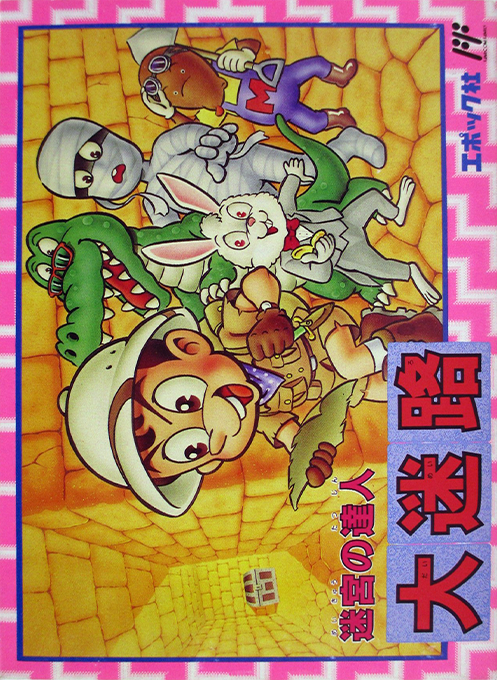
Dai Meiro - Meikyuu no Tatsujin
In Dai Meiro: Meikyuu no Tatsujin the player must navigate a 3D maze and reach the goal. Along the way, the player needs to find all the special items to open the last door. With each step, the player's POW is depleted, which can be regenerated by collecting items along the way. There are secret rooms and items that can assist the player in reaching the goal. There are also three mini-games that can be found in the maze. A mini-map can be brought up, but this will cost POW. The game has no combat to speak of or random encounters. There are three levels of difficulty, which completely changes the layout of the mazes.
- AI score · out of 10
- 7.3 / 10
About this game
In Dai Meiro: Meikyuu no Tatsujin the player must navigate a 3D maze and reach the goal. Along the way, the player needs to find all the special items to open the last door. With each step, the player's POW is depleted, which can be regenerated by collecting items along the way. There are secret rooms and items that can assist the player in reaching the goal. There are also three mini-games that can be found in the maze. A mini-map can be brought up, but this will cost POW. The game has no combat to speak of or random encounters. There are three levels of difficulty, which completely changes the layout of the mazes.
Recommended games
Related game recommendations on this platform
Famicom / NES

AI review
AI reviews are subjective assessments, not player ratings. See each review for its evidence and limitations.Published date:
Dai Meiro - Meikyuu no Tatsujin is assessed here as a specific FC/NES release with its documented strengths and practical limits kept in view.
In Dai Meiro: Meikyuu no Tatsujin the player must navigate a 3D maze and reach the goal. Along the way, the player needs to find all the special items to open the last door. With each step, the player's POW is depleted, which can be regenerated by collecting items along the way. There are secret rooms and items that can assist the player in reaching the goal. There are also three mini-games that can be found in the maze. A mini-map can be brought up, but this will cost POW. The game has no combat to speak of or random encounters. There are three levels This assessment focuses on the specific FC or NES release and on the play actions, goals, and progression documented for Dai Meiro - Meikyuu no Tatsujin. Its value comes from how clearly the central rules create decisions and feedback across a session. Pacing is judged by the variety of situations, the learning curve, recovery after failure, and the reason to replay. Presentation is considered through readability, animation, sound, and the consistency of the game's style rather than by modern resolution. Practical limits such as period controls, guidance, saving, or required accessories are included only when they affect this release. Players who enjoy learning compact systems and improving through repeated attempts are the clearest audience, while
Strengths
- The documented central loop gives Dai Meiro - Meikyuu no Tatsujin a clear identity and a learnable set of goals.
- Progress rewards understanding the rules and applying them more consistently across repeated situations.
Weaknesses
- The original release can create friction through its documented difficulty, guidance, control, or recovery limits.
Who it is for: Players interested in the original FC/NES design and willing to learn its period-specific rules.
Play notes: Check the documented language, saving, accessory, and recovery conditions for this exact release.
View scoring basis
| Dimension | Review state | Score | Weight |
|---|---|---|---|
| Dimension The content pacing score applies the V3 boundary to the documented mechanics, pacing, presentation, and FC release constraints. | Reviewed | 7.3 / 10 | Not provided |
| Dimension The core experience score applies the V3 boundary to the documented mechanics, pacing, presentation, and FC release constraints. | Reviewed | 7.2 / 10 | Not provided |
| Dimension The presentation immersion score applies the V3 boundary to the documented mechanics, pacing, presentation, and FC release constraints. | Reviewed | 7.9 / 10 | Not provided |
| Dimension The technical usability score applies the V3 boundary to the documented mechanics, pacing, presentation, and FC release constraints. | Reviewed | 6.8 / 10 | Not provided |
Review sources
Not provided
Core information
- Developer
- Epoch
- Publisher
- Epoch
- Release date
- 1990
- Platforms
- Famicom / NES
- Content kind
- Game
- Release state
- Released
- Region
- Worldwide
- Official website
- Not provided
- Offline minimum players
- Not provided
- Offline maximum players
- Not provided
- Online minimum players
- Not provided
- Online maximum players
- Not provided
- Categories
- Role-Playing · Primary genre
- Tags
- Pixel ArtRetro Style2D GraphicsExplorationCollection-richPuzzle SolvingSolo-friendly
- Supported game languages
- Not provided
- Requires base game
- Not provided
- Standalone
- Not provided
- Age ratings
- Not provided
- Play modes
- Not provided
- Perspectives
- Not provided
Release editions
- Famicom / NESWorldwide1990
Game gallery
Sources
Not provided