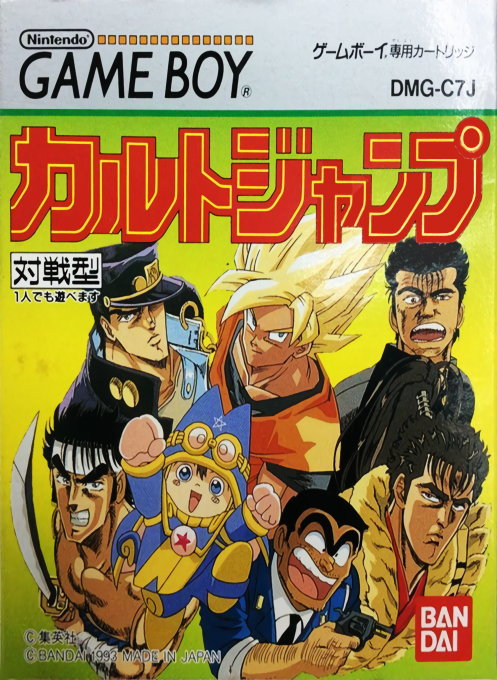
Cult Jump
Cult Jump is a Game Boy puzzle game released in 1993 developed by Sun L. It centers on story, case, or mission progress, rule recognition, and spatial or logical judgment, with controls, information, and pacing arranged around a monochrome small screen, a directional pad, and two main action buttons.
- AI score · out of 10
- 6.3 / 10
About this game
Cult Jump is a Game Boy puzzle release centered on story, case, or mission progress, rule recognition, and spatial or logical judgment. Compact stages add conditions and tighter constraints over time, with progress divided into stages, tasks, matches, or growth milestones that make its immediate goals understandable. Its value depends on whether these rules continue to create judgment and room for mastery rather than on campaign length or series recognition. Short campaigns are judged by repeat-challenge value, while longer ones are judged by variety, pacing, and recovery after failure. Graphics, audio cues, and state feedback need to support decisions directly, while silhouettes, contrast, and audio cues need to remain clear on the monochrome display. The main genre-specific friction is that limited explanations, repetition, or abrupt difficulty can stall progress. In addition, password or battery saves, link-cable requirements, display blur, manual dependence, and regional language can affect use of the original cartridge today. This description covers only this release and excludes emulator features, modern-port conveniences, and content from other platforms.
Recommended games
Related game recommendations on this platform
Game Boy (GB)

AI review
AI reviews are subjective assessments, not player ratings. See each review for its evidence and limitations.Published date:
A clever Jump-trivia tower game with an exceptionally narrow language and fandom audience.
Cult Jump is not merely a reference cartridge: it turns knowledge of Weekly Shonen Jump manga into combat. The player climbs quiz towers, choosing answers to damage enemies while wrong replies remove health. Bosses ask players to identify gradually revealed character pictures, and recovery or protective items add modest resource choices. Fifty stages create a sizable structure for anyone who knows the late-1980s and early-1990s magazine lineup. Recognizing a character is itself the reward for a devoted reader. For others, Japanese text and period-specific questions shut off the central interaction, so the crossover names do not automatically create an accessible RPG. Monochrome figures and a slight framing story support the quizzes rather than building a rich separate adventure. Each stage issues a password for continuation, requiring the player to record it. The score recognizes an unusual transformation of fandom knowledge into play, then accounts for repeated question structure and extreme audience dependence. It judges the original Game Boy release, not a translated or modernized adaptation.
Strengths
- Manga knowledge is meaningfully tied to combat
- Picture bosses and items vary the quiz routine
Weaknesses
- Japanese and period manga expertise required
- Long quiz climb can become repetitive
Who it is for: Japanese-reading fans of classic Weekly Shonen Jump.
Play notes: Original Game Boy Japanese quiz content; record stage passwords.
View scoring basis
| Dimension | Review state | Score | Weight |
|---|---|---|---|
| Dimension Boss identification and consumables add small tactical choices beyond ordinary trivia. | Reviewed | 6.3 / 10 | Not provided |
| Dimension Magazine knowledge becomes the combat skill, creating a distinct game for devoted readers. | Reviewed | 6.6 / 10 | Not provided |
| Dimension Crossover recognition matters more than graphical spectacle or a strong original plot. | Reviewed | 6.0 / 10 | Not provided |
| Dimension Progress can be resumed but requires note-taking; language and period fandom sharply limit accessibility. | Reviewed | 5.7 / 10 | Not provided |
Review sources
Not provided
Core information
- Developer
- Sun L
- Publisher
- Bandai
- Release date
- 1993
- Platforms
- Game Boy (GB)
- Content kind
- Game
- Release state
- Released
- Region
- Worldwide
- Official website
- Not provided
- Offline minimum players
- Not provided
- Offline maximum players
- Not provided
- Online minimum players
- Not provided
- Online maximum players
- Not provided
- Categories
- Puzzle · Primary genre
- Tags
- Solo-friendlyMain Story Under 10 HoursLow Entry BarrierShort SessionsStory-drivenFixed CameraReplayablePick-up and Play2D GraphicsPuzzle SolvingSlow Burn
- Supported game languages
- Not provided
- Requires base game
- Not provided
- Standalone
- Not provided
- Age ratings
- Not provided
- Play modes
- Not provided
- Perspectives
- Not provided
Release editions
- Game Boy (GB)Worldwide1993
Game gallery
Sources
Not provided