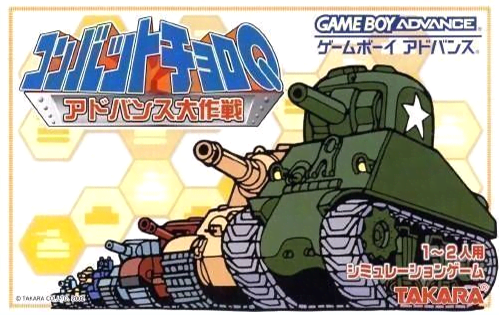
Combat Choro Q - Advance Daisakusen
Combat Choro Q - Advance Daisakusen is a Game Boy Advance strategy game built around resource planning, unit control, and tactical judgment, and turn-based tactical decisions. Successive missions add rules, map constraints, and tougher opposition. Its goals and feedback are arranged for portable play.
- AI score · out of 10
- 6.9 / 10
About this game
Combat Choro Q: Advance Daisakusen is a Strategy game, developed by Access and published by Takara, which was released in Japan in 2002. Combat Choro Q - Advance Daisakusen organizes its handheld version around resource planning, unit control, and tactical judgment, and turn-based tactical decisions. Successive missions add rules, map constraints, and tougher opposition. Map information, unit states, and action feedback determine readability, while brief tutorials, dense menus, and long scenarios increase the learning curve. This description applies only to the Game Boy Advance release and does not import features from console or later editions.
Collected in series
Choro Q is best known for racing tiny, exaggerated cars and fitting new parts to change how they drive. Some entries take those cars beyond the track, letting you roam towns, meet other vehicles and earn upgrades through small adventures.
Recommended games
Related game recommendations on this platform
Game Boy Advance
AI review
AI reviews are subjective assessments, not player ratings. See each review for its evidence and limitations.Published date:
Rewarding decisions backed by a meaningful learning curve
Combat Choro Q - Advance Daisakusen centers on resource planning, unit control, and tactical judgment, and turn-based tactical decisions. Successive missions add rules, map constraints, and tougher opposition, giving the handheld release a recognizable rhythm and a clear set of player goals. Map information, unit states, and action feedback determine readability, and the best parts connect readable objectives with steady mechanical feedback. Brief tutorials, dense menus, and long scenarios increase the learning curve, which is the main reason the original cartridge can feel less approachable today. This GameNavo assessment uses the release description, classification, media record, and retained source evidence. It does not import user ratings, press aggregates, emulator conveniences, or features belonging to console versions and later remakes.
Strengths
- The central loop connects resource planning, unit control, and tactical judgment, and turn-based tactical decisions with readable goals.
- Progress has a clear structure and introduces recognizable stage or system changes.
- Presentation supports the rules with useful visual and audio feedback.
Weaknesses
- Brief tutorials, dense menus, and long scenarios increase the learning curve.
- The original GBA release lacks modern conveniences such as rewind, save states, and expanded tutorials.
Who it is for: Players who enjoy strategy games, accept period-specific handheld controls, and want to understand the original release on its own terms.
Play notes: This assessment is based on documented release evidence rather than a full playthrough; language, link hardware, and cartridge save condition may affect use. This score was recalibrated under professional-v2 without external ratings, source volume, asset count, title recognition, or URL-derived values.
View scoring basis
| Dimension | Review state | Score | Weight |
|---|---|---|---|
| Dimension Content and pacing are judged from progression, variety, repetition, recovery after failure, and meaningful replay value in this release. The 6.8 score does not reward description length, media count, or a longer nominal playtime. | Reviewed | 6.8 / 10 | Not provided |
| Dimension The GBA release is judged on its actual main loop, control feedback, rule depth, and room for mastery. This 7.0 score reflects the release itself and excludes title recognition, source volume, URL data, and external ratings. | Reviewed | 7.0 / 10 | Not provided |
| Dimension Presentation is assessed through the GBA release's readability, art, sound, interface, atmosphere, and relevant narrative expression. Era-normal resolution is not penalized, while release-specific clarity problems remain part of the 7.0 score. | Reviewed | 7.0 / 10 | Not provided |
| Dimension Technical usability covers response, information clarity, saving and continuation, language, accessories, and stability in the original GBA release. Emulator conveniences are excluded from this 6.4 score. | Reviewed | 6.4 / 10 | Not provided |
Review sources
Not provided
Core information
- Developer
- Access Games
- Publisher
- Takara Tomy
- Release date
- 2002
- Platforms
- Game Boy Advance
- Content kind
- Game
- Release state
- Released
- Region
- Worldwide
- Official website
- Not provided
- Offline minimum players
- Not provided
- Offline maximum players
- Not provided
- Online minimum players
- Not provided
- Online maximum players
- Not provided
- Categories
- Strategy & Tactics · Primary genre
- Tags
- Command-based CombatSlow BurnTop-downReplayableResource ManagementLong-term ProgressionSolo-friendly2D GraphicsTurn-based Tactics
- Supported game languages
- Not provided
- Requires base game
- Not provided
- Standalone
- Not provided
- Age ratings
- Not provided
- Play modes
- Not provided
- Perspectives
- Not provided
Release editions
- Game Boy AdvanceWorldwide2002
Game gallery
Sources
Not provided