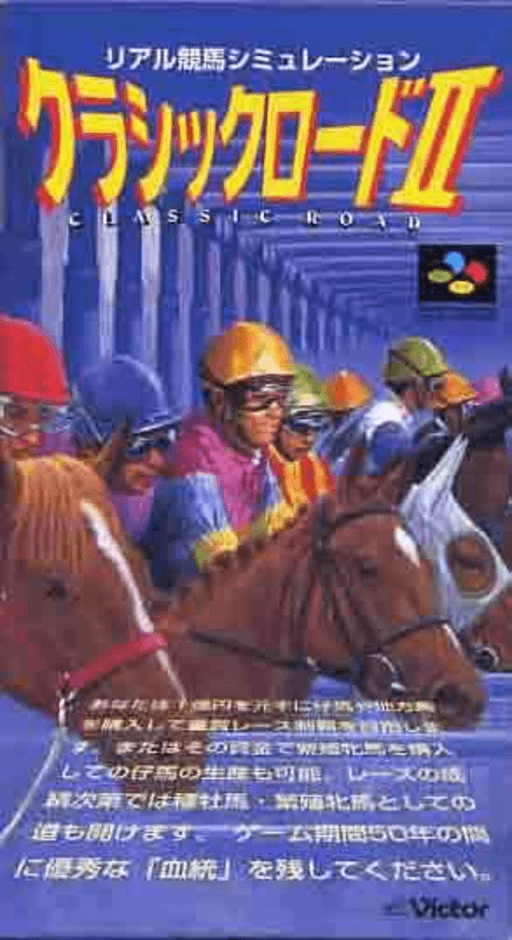
Classic Road 2
Classic Road 2 is a Super Famicom specialized game released in 1995 developed by Opera House. It centers on driving and route control, theme-specific rule learning, and button interaction, with controls, information, and pacing arranged around television output, a directional pad, shoulder buttons, and a six-button controller.
- AI score · out of 10
- 6.3 / 10
About this game
Classic Road 2 is a Super Famicom specialized release centered on driving and route control, theme-specific rule learning, and button interaction. Content unfolds through exercises, tasks, or staged objectives, with progress divided into stages, tasks, matches, or growth milestones that make its immediate goals understandable. Its value depends on whether these rules continue to create judgment and room for mastery rather than on campaign length or series recognition. Short campaigns are judged by repeat-challenge value, while longer ones are judged by variety, pacing, and recovery after failure. Interface, theme, and feedback establish the work's identity, while sprite animation, scrolling, color, and chip-based audio jointly carry readability and atmosphere. The main genre-specific friction is that an unusual genre fit, explanation style, and language can hinder understanding. In addition, password or battery saves, multiplayer accessories, manual dependence, regional language, and cartridge enhancement chips can affect original-hardware use. This description covers only this release and excludes emulator features, modern-port conveniences, and content from other platforms.
Recommended games
Related game recommendations on this platform
Super Famicom / SNES

AI review
AI reviews are subjective assessments, not player ratings. See each review for its evidence and limitations.Published date:
Developing winners is satisfying, but harsh injuries and calendar work slow progress.
Classic Road 2 focuses on developing winning horses rather than riding every race yourself. Training, weight and recovery interact, and careful preparation can produce satisfying GI victories. Ordinary training adds little growth, however, concentrating useful preparation around intensive work and recuperation, with injuries still threatening that investment. Stable scenes, portraits and horse profiles make management concrete; grouped attributes and schedules complement a separate racing position overview. Pacing is the larger problem. Serious injuries can mean lengthy treatment or retirement, diagnosis takes successive weeks, and the fifty-year ending can leave empty date advancement after sporting goals are achieved. L/R calendar paging and autosaving help, but notifications interrupt advancement. It suits players who set their own racing goals and tolerate disrupted development rather than expecting reliable weekly rewards.
Strengths
- Training, weight and rest create practical choices, with GI wins rewarding careful horse development.
- Stable scenes, portraits, horse profiles and grouped race information give management a concrete setting.
- L/R calendar paging and automatic saving provide basic convenience for a lengthy management career.
Weaknesses
- Ordinary training yields little growth, concentrating effective preparation around repeated intensive work and recovery.
- Lengthy injuries or retirement disrupt development, while the fifty-year ending can leave empty calendar work.
- Diagnosis arrives across weeks and notifications interrupt advancement, adding friction to checking state and skipping dates.
Who it is for: Simulation players who enjoy developing horses, set their own GI or earnings goals, can read Japanese management information, and tolerate injury setbacks, long recovery and calendar progression.
Play notes: This covers the original 1995 SFC release, not the later PlayStation namesake. Monitor fatigue, weight and successive-week diagnosis; serious injuries can end a horse's career. Autosaving supports continuation and L/R pages the calendar, but notifications interrupt advancement.
View scoring basis
| Dimension | Review state | Score | Weight |
|---|---|---|---|
| Dimension Champion development offers personal goals, and recorded GI wins show that preparation can pay off. Yet the fifty-year ending can be reached through empty date advancement, making the later stretch calendar work. Lengthy injury recovery or retirement can interrupt development. These waits and setbacks significantly weaken pacing despite the rewards of success. | Reviewed | 5.2 / 10 | Not provided |
| Dimension Training, weight and recovery interact, and careful development can produce GI victories. The management loop therefore has a genuine payoff. Ordinary training raises attributes little, however, concentrating useful preparation around intensive work, and fatigue precautions do not eliminate injuries. The choices are workable but constrained and difficult to trust. | Reviewed | 6.7 / 10 | Not provided |
| Dimension A receding stable scene, character portrait and horse profile make management concrete. Attributes, scheduled activities and results are grouped, while the race scene separates the course from a position overview. The inspected daily and racing scenes provide coherent surroundings and a recognisable hierarchy, supporting good visual expression and investment in the horses. | Reviewed | 7.0 / 10 | Not provided |
| Dimension L/R paging and automatic saving support a continuing management game, with useful scope for advancing dates. Notifications interrupt that advance, however, and injury information arrives across successive weeks. The software is basically usable, but long-range skipping and promptly confirming a horse's state involve substantial friction. | Reviewed | 6.1 / 10 | Not provided |
Review sources
Not provided
Core information
- Developer
- Opera House
- Publisher
- Victor Interactive Software
- Release date
- 1995
- Platforms
- Super Famicom / SNES
- Content kind
- Game
- Release state
- Released
- Region
- Worldwide
- Official website
- Not provided
- Offline minimum players
- Not provided
- Offline maximum players
- Not provided
- Online minimum players
- Not provided
- Online maximum players
- Not provided
- Categories
- Management & Building · Primary genre
- Tags
- Slow BurnLong-term Progression2D GraphicsReplayableSolo-friendlyResource Management
- Supported game languages
- Not provided
- Requires base game
- Not provided
- Standalone
- Not provided
- Age ratings
- Not provided
- Play modes
- Not provided
- Perspectives
- Not provided
Release editions
- Super Famicom / SNESWorldwide1995
Game gallery
Sources
Not provided