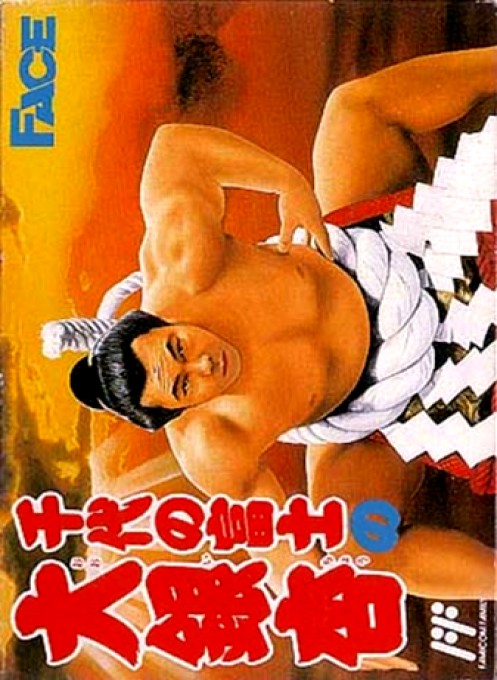
Chiyonofuji no Ooichou
The player is able to customize their own sumo wrestler by giving him a unique appearance. Characters have a chibi appearance to them. Items that can be added include are the eyes, ears, mouth, and nose. Once the customized wrestler is created, he must fight against other sumo wrestlers for the title of Yokozuna. There are two bars for each player that allow the player to fend off and deliver attacks. A tutorial mode is added that allows players to practice their moves against an AI opponent that is lower in intellect that the actual game's AI.
- AI score · out of 10
- 7.6 / 10
About this game
The player is able to customize their own sumo wrestler by giving him a unique appearance. Characters have a chibi appearance to them. Items that can be added include are the eyes, ears, mouth, and nose. Once the customized wrestler is created, he must fight against other sumo wrestlers for the title of Yokozuna. There are two bars for each player that allow the player to fend off and deliver attacks. A tutorial mode is added that allows players to practice their moves against an AI opponent that is lower in intellect that the actual game's AI.
Recommended games
Related game recommendations on this platform
Famicom / NES
AI review
AI reviews are subjective assessments, not player ratings. See each review for its evidence and limitations.Published date:
Chiyonofuji no Ooichou is assessed here as a specific FC/NES release with its documented strengths and practical limits kept in view.
The player is able to customize their own sumo wrestler by giving him a unique appearance. Characters have a chibi appearance to them. Items that can be added include are the eyes, ears, mouth, and nose. Once the customized wrestler is created, he must fight against other sumo wrestlers for the title of Yokozuna. There are two bars for each player that allow the player to fend off and deliver attacks. A tutorial mode is added that allows players to practice their moves against an AI opponent that is lower in intellect that the actual game's AI. This assessment focuses on the specific FC or NES release and on the play actions, goals, and progression documented for Chiyonofuji no Ooichou. Its value comes from how clearly the central rules create decisions and feedback across a session. Pacing is judged by the variety of situations, the learning curve, recovery after failure, and the reason to replay. Presentation is considered through readability, animation, sound, and the consistency of the game's style rather than by modern resolution. Practical limits such as period controls, guidance, saving, or required accessories are included only when they affect this release. Players who enjoy learning compact systems and improving through repeated attempts are the clearest audience, while anyone seeking modern convenience should review those version-specific limits first.
Strengths
- The documented central loop gives Chiyonofuji no Ooichou a clear identity and a learnable set of goals.
- Progress rewards understanding the rules and applying them more consistently across repeated situations.
Weaknesses
- The original release can create friction through its documented difficulty, guidance, control, or recovery limits.
Who it is for: Players interested in the original FC/NES design and willing to learn its period-specific rules.
Play notes: Check the documented language, saving, accessory, and recovery conditions for this exact release.
View scoring basis
| Dimension | Review state | Score | Weight |
|---|---|---|---|
| Dimension The content pacing score applies the V3 boundary to the documented mechanics, pacing, presentation, and FC release constraints. | Reviewed | 7.6 / 10 | Not provided |
| Dimension The core experience score applies the V3 boundary to the documented mechanics, pacing, presentation, and FC release constraints. | Reviewed | 7.5 / 10 | Not provided |
| Dimension The presentation immersion score applies the V3 boundary to the documented mechanics, pacing, presentation, and FC release constraints. | Reviewed | 7.9 / 10 | Not provided |
| Dimension The technical usability score applies the V3 boundary to the documented mechanics, pacing, presentation, and FC release constraints. | Reviewed | 7.2 / 10 | Not provided |
Review sources
Not provided
Core information
- Developer
- Arc System Works
- Publisher
- Face
- Release date
- 1990
- Platforms
- Famicom / NES
- Content kind
- Game
- Release state
- Released
- Region
- Worldwide
- Official website
- Not provided
- Offline minimum players
- Not provided
- Offline maximum players
- Not provided
- Online minimum players
- Not provided
- Online maximum players
- Not provided
- Categories
- Sports · Primary genre
- Tags
- Pixel Art2D GraphicsSolo-friendlyJapanese-inspired StyleRetro StyleSports-based Play
- Supported game languages
- Not provided
- Requires base game
- Not provided
- Standalone
- Not provided
- Age ratings
- Not provided
- Play modes
- Not provided
- Perspectives
- Not provided
Release editions
- Famicom / NESWorldwide1990
Game gallery
Sources
Not provided