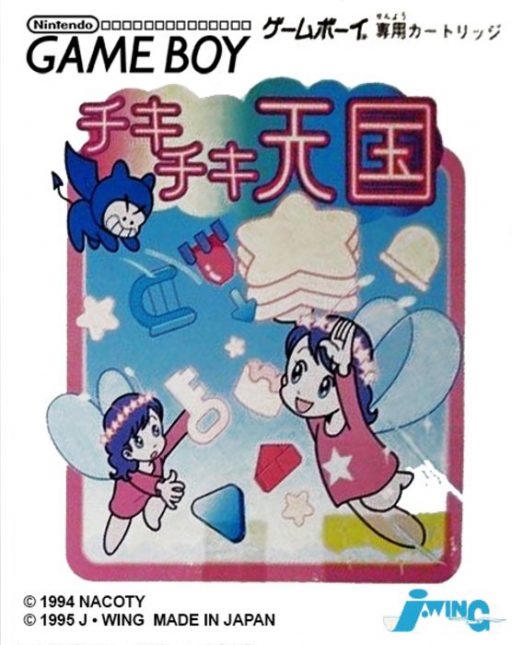
Chiki Chiki Tengoku
Chiki Chiki Tengoku is a Game Boy puzzle game released in 1995 developed by J-Wing. It centers on puzzle, maze, or device solving, rule recognition, and spatial or logical judgment, with controls, information, and pacing arranged around a monochrome small screen, a directional pad, and two main action buttons.
- AI score · out of 10
- 6.4 / 10
About this game
Chiki Chiki Tengoku is a Game Boy puzzle release centered on puzzle, maze, or device solving, rule recognition, and spatial or logical judgment. Compact stages add conditions and tighter constraints over time, with progress divided into stages, tasks, matches, or growth milestones that make its immediate goals understandable. Its value depends on whether these rules continue to create judgment and room for mastery rather than on campaign length or series recognition. Short campaigns are judged by repeat-challenge value, while longer ones are judged by variety, pacing, and recovery after failure. Graphics, audio cues, and state feedback need to support decisions directly, while silhouettes, contrast, and audio cues need to remain clear on the monochrome display. The main genre-specific friction is that limited explanations, repetition, or abrupt difficulty can stall progress. In addition, password or battery saves, link-cable requirements, display blur, manual dependence, and regional language can affect use of the original cartridge today. This description covers only this release and excludes emulator features, modern-port conveniences, and content from other platforms.
Recommended games
Related game recommendations on this platform
Game Boy (GB)

AI review
AI reviews are subjective assessments, not player ratings. See each review for its evidence and limitations.Published date:
Multi-step clearing rewards planning, but learning and later rebuilding weigh on the rhythm.
Chiki Chiki Tengoku does not clear a match immediately. Three matching pieces form stars; seven across create fairies, whose obstructions must be removed to clear the board. This gives a small playfield meaningful planning and satisfying chains, but the relationships are not intuitive. Later leftovers often demand rebuilding, so partial success need not finish a round. Twenty-five rounds add pieces and obstacles, while transformation and bomb tools change larger areas. Fairies rise individually and slow the default rhythm, although A accelerates them. Bidirectional rotation, pause and three initial speeds support practice. The fairy title establishes a light theme within modest presentation. It suits players studying full-board solutions; absent tutorial, password recovery and high-score storage make learning and organizing extended challenges across sessions less friendly.
Strengths
- Star formation, obstruction removal and full-board clearing reward chains and multi-step planning.
- Later pieces, obstacles and transformation/bomb tools genuinely expand clearing choices.
- Bidirectional rotation, pause, initial speed selection and fairy acceleration support practice and adjustment.
Weaknesses
- Unintuitive multi-step rules, cramped space and later rebuilding limit recovery room.
- Default sequential fairy ascent interrupts the rhythm, although A can accelerate it.
- No tutorial, password recovery or high-score storage limits learning and cross-session challenge support.
Who it is for: Falling-piece puzzle players willing to read the rules and study chains and full-board solutions, while accepting later rebuilding and limited recovery across sessions.
Play notes: This covers the original 1995 Game Boy Chiki Chiki Tengoku. A rotates clockwise, B counterclockwise, Down accelerates falling and A also speeds fairy ascent. Start pauses; A continues after GameOver. Choose a suitable initial speed and understand blocked ascent first. Longer challenges have no password-recovery support.
View scoring basis
| Dimension | Review state | Score | Weight |
|---|---|---|---|
| Dimension Twenty-five rounds expand decisions through added pieces, obstacles and later transformation/bomb tools, giving progression a clear endpoint and meaningful changes. Default sequential ascent interrupts rhythm, although A acceleration offers practical relief. Later clearing burdens also grow, so progression varies without consistently feeling brisk; the issue is not simply its mode count. | Reviewed | 6.3 / 10 | Not provided |
| Dimension Multi-step star formation and clearing create meaningful planning, with genuine chain satisfaction; complexity is not inherently bad design. The concrete limitations are difficult-to-grasp relationships, cramped recovery space and later rebuilding around leftovers. The core basically works, but successful moves do not always translate promptly into completion rewards. | Reviewed | 6.2 / 10 | Not provided |
| Dimension A clear title entry and fairy figure establish a light fantasy identity that basically serves the game. The restrained presentation carries its theme through relatively few symbols, with limited elaboration. Its strength is an explicit, light thematic introduction, rather than substantial development of that fantasy atmosphere. | Reviewed | 6.6 / 10 | Not provided |
| Dimension Bidirectional rotation, pause, speed selection and a continue entry are verified conveniences supporting practice and immediate adjustment. Missing tutorial, password recovery and high-score storage make learning the multi-step rules and organizing longer challenges across sessions less friendly. Practical inputs work, while learning and record functions remain limited. | Reviewed | 6.6 / 10 | Not provided |
Review sources
Not provided
Core information
- Developer
- J-Wing
- Publisher
- J-Wing
- Release date
- 1995
- Platforms
- Game Boy (GB)
- Content kind
- Game
- Release state
- Released
- Region
- Worldwide
- Official website
- Not provided
- Offline minimum players
- Not provided
- Offline maximum players
- Not provided
- Online minimum players
- Not provided
- Online maximum players
- Not provided
- Categories
- Puzzle · Primary genre
- Tags
- Solo-friendlyFixed CameraShort SessionsReplayablePuzzle SolvingMain Story Under 10 HoursSlow Burn2D GraphicsLow Entry BarrierPick-up and Play
- Supported game languages
- Not provided
- Requires base game
- Not provided
- Standalone
- Not provided
- Age ratings
- Not provided
- Play modes
- Not provided
- Perspectives
- Not provided
Release editions
- Game Boy (GB)Worldwide1995
Game gallery
Sources
Not provided