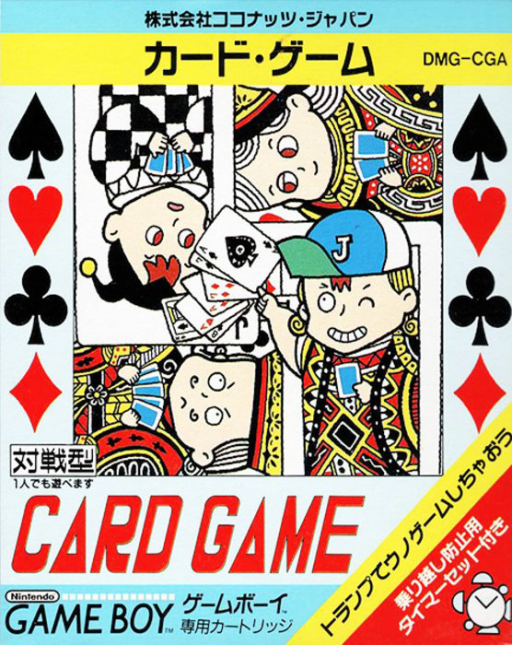
Card Game
Card Game is a Game Boy card and board game released in 1990 developed by Marionette. It centers on collection and development goals, card or board-game rules, and rules interaction, with controls, information, and pacing arranged around a monochrome small screen, a directional pad, and two main action buttons.
- AI score · out of 10
- 6.4 / 10
About this game
Card Game is a Game Boy card and board release centered on collection and development goals, card or board-game rules, and rules interaction. Matches, decks, or board objectives create a repeatable strategy loop, with progress divided into stages, tasks, matches, or growth milestones that make its immediate goals understandable. Its value depends on whether these rules continue to create judgment and room for mastery rather than on campaign length or series recognition. Short campaigns are judged by repeat-challenge value, while longer ones are judged by variety, pacing, and recovery after failure. Card, board, and state readability determine usability, while silhouettes, contrast, and audio cues need to remain clear on the monochrome display. The main genre-specific friction is that rules terminology, opponent pacing, and text density raise the entry barrier. In addition, password or battery saves, link-cable requirements, display blur, manual dependence, and regional language can affect use of the original cartridge today. This description covers only this release and excludes emulator features, modern-port conveniences, and content from other platforms.
Recommended games
Related game recommendations on this platform
Game Boy (GB)

AI review
AI reviews are subjective assessments, not player ratings. See each review for its evidence and limitations.Published date:
Clear card-table information offset by exploitable opponents and repetitive accumulation.
Card Game combines poker, blackjack and US Page One around a shared chip challenge. Drawing cards, splitting, insurance and special cards that change suits or turn order provide real decisions rather than passive results. The inspected poker screens separate hands, funds, wagers and actions, then explain the showdown through visible hand labels. The main weakness is staying power. Opponents fold readily and their betting tendencies reveal broad hand strength, reducing pressure once those habits are understood. Page One is lengthy, difficult to win and relatively unrewarding, so reaching the 100000-chip ending can concentrate play on repeated poker. Choosing End after results preserves chips when returning to game selection, but B at that menu resets them through the title screen. It suits rule practice more than durable bluffing competition.
Strengths
- Drawing, splitting and special cards give the three games distinct decisions.
- Poker screens clearly separate cards, funds, wagers and showdown labels.
- End preserves chips when returning to the game-selection menu.
Weaknesses
- Readable betting tendencies and frequent folding weaken computer poker opposition.
- Lengthy, low-paying Page One sessions make accumulation lean toward repetitive poker.
- Returning to the title with B resets accumulated chips.
Who it is for: Players interested in practicing different card rules who can accept exploitable computer habits and a lengthy chip-accumulation goal.
Play notes: This covers the original Japanese GB software. Choose End on a result screen to retain chips at game selection; B from that menu returns to the title and resets them. The 100000-chip target is an in-game objective, not a cash reward.
View scoring basis
| Dimension | Review state | Score | Weight |
|---|---|---|---|
| Dimension Different rules offer pacing alternatives, but lengthy, low-paying Page One sessions serve the 100000-point goal poorly. Progress tends toward repeated poker, with limited variation to sustain that accumulation. | Reviewed | 5.8 / 10 | Not provided |
| Dimension Drawing, splitting and special-card decisions give the three games meaningful choices. Predictable betting tendencies and frequent folding weaken poker's hidden-information contest, making the collection functional rather than consistently compelling. | Reviewed | 6.5 / 10 | Not provided |
| Dimension The inspected poker screens separate cards, funds, actions and hand labels, with results showing both hands. Their restrained layout serves the card-table task well through clear information rather than decoration. | Reviewed | 7.0 / 10 | Not provided |
| Dimension Betting and card-exchange inputs are explicit, and End preserves chips when returning to game selection. B instead resets them at the title screen, making an exit mistake costly during long-term accumulation. | Reviewed | 6.2 / 10 | Not provided |
Review sources
Not provided
Core information
- Developer
- Marionette
- Publisher
- Coconuts Japan
- Release date
- 1990
- Platforms
- Game Boy (GB)
- Content kind
- Game
- Release state
- Released
- Region
- Worldwide
- Official website
- Not provided
- Offline minimum players
- Not provided
- Offline maximum players
- Not provided
- Online minimum players
- Not provided
- Online maximum players
- Not provided
- Categories
- Card & Tabletop · Primary genre
- Tags
- Card PlayBoard and Tabletop PlaySolo-friendlyTurn-based TacticsSlow BurnCollection-rich
- Supported game languages
- Not provided
- Requires base game
- Not provided
- Standalone
- Not provided
- Age ratings
- Not provided
- Play modes
- Single player
- Perspectives
- Not provided
Release editions
- Game Boy (GB)Worldwide1990
Game gallery
Sources
Not provided