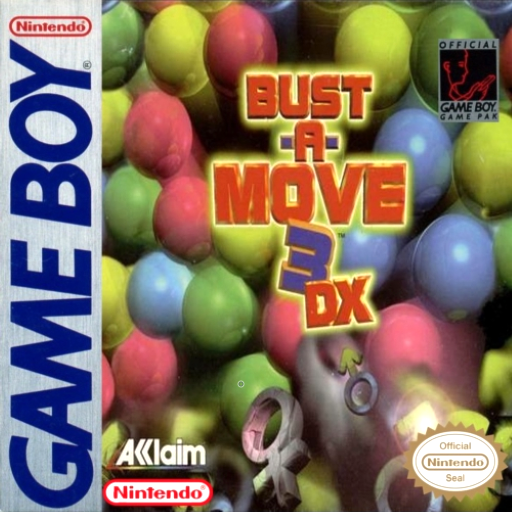
Bust-A-Move 3 DX
Bust-A-Move 3 DX is a Game Boy puzzle game released in 1998 developed by Taito. It centers on puzzle, maze, or device solving, rule recognition, and spatial or logical judgment, with controls, information, and pacing arranged around a monochrome small screen, a directional pad, and two main action buttons.
- AI score · out of 10
- 7.1 / 10
About this game
Bust-A-Move 3 DX is a Game Boy puzzle release centered on puzzle, maze, or device solving, rule recognition, and spatial or logical judgment. Compact stages add conditions and tighter constraints over time, with progress divided into stages, tasks, matches, or growth milestones that make its immediate goals understandable. Its value depends on whether these rules continue to create judgment and room for mastery rather than on campaign length or series recognition. Short campaigns are judged by repeat-challenge value, while longer ones are judged by variety, pacing, and recovery after failure. Graphics, audio cues, and state feedback need to support decisions directly, while silhouettes, contrast, and audio cues need to remain clear on the monochrome display. The main genre-specific friction is that limited explanations, repetition, or abrupt difficulty can stall progress. In addition, password or battery saves, link-cable requirements, display blur, manual dependence, and regional language can affect use of the original cartridge today. This description covers only this release and excludes emulator features, modern-port conveniences, and content from other platforms.
Recommended games
Related game recommendations on this platform
Game Boy (GB)

AI review
AI reviews are subjective assessments, not player ratings. See each review for its evidence and limitations.Published date:
The bubble-matching heart survives, while the Game Boy package narrows modes and visual cues.
The 1998 European Game Boy Bust-A-Move 3 DX retains the simple act of aiming a launcher, joining matching bubbles and dropping clusters that depend on them. Planning rebounds and deciding which group to remove should still create satisfying short-session puzzles. That is a cautious judgment from the documented rules, not a claim that this reviewer played the original cartridge. Sources for the specific handheld version list a solo arcade path, an AI-opponent option and a 25-stage challenge mode. Those are useful portable activities, but the large collection and editing modes found in similarly named home-console releases must not be credited to this cartridge. On original Game Boy hardware, bubble types are differentiated by shades rather than the colours used elsewhere. Since recognising those types is the central decision, the small monochrome display imposes a real information cost, not a penalty merely for old hardware. A European cartridge catalogue also records no save feature; whether some other continuation method exists has not been independently confirmed. The assessment therefore makes no assertion about total completion time, sound quality or measured input response. Several reviews indexed under Game Boy actually discuss PlayStation, Saturn or Nintendo 64 and were excluded. This is a good option for players who want familiar bubble puzzles on a genuine GB, while those seeking the fullest mode selection and colour clarity may prefer another release.
Strengths
- Core aim, match and chain-drop rules suit brief play
- Solo arcade, AI opposition and 25 challenge rounds remain
- Clear original Game Boy release identity
Weaknesses
- Fewer modes than similarly titled console editions
- Shades require more visual discrimination than colour
- No save feature documented for this cartridge
Who it is for: Puzzle Bobble fans wanting short matching sessions on original Game Boy hardware.
Play notes: This is an evidence-based inference, not a GB hands-on test; no PlayStation, Saturn or N64 features or performance are assumed.
View scoring basis
| Dimension | Review state | Score | Weight |
|---|---|---|---|
| Dimension Arcade and 25 challenge stages fit portable sessions, with fewer modes and no verified save. | Reviewed | 6.7 / 10 | Not provided |
| Dimension Aim-and-match rules retain strategic potential; this is an inference, not a playtest. | Reviewed | 7.7 / 10 | Not provided |
| Dimension Tonal bubbles convey the rules, though monochrome reading takes care on a small screen. | Reviewed | 6.6 / 10 | Not provided |
| Dimension The simple task suits GB play, with tonal and save limitations; response is untested. | Reviewed | 6.7 / 10 | Not provided |
Review sources
Not provided
Core information
- Developer
- Taito
- Publisher
- Crawfish InteractiveProbeAcclaim
- Release date
- 1998
- Platforms
- Game Boy (GB)
- Content kind
- Game
- Release state
- Released
- Region
- Worldwide
- Official website
- Not provided
- Offline minimum players
- Not provided
- Offline maximum players
- Not provided
- Online minimum players
- Not provided
- Online maximum players
- Not provided
- Categories
- Puzzle · Primary genre
- Tags
- Puzzle SolvingPick-up and PlaySolo-friendlyFixed CameraLow Entry Barrier2D GraphicsMain Story Under 10 HoursReplayableShort SessionsSlow Burn
- Supported game languages
- Not provided
- Requires base game
- Not provided
- Standalone
- Not provided
- Age ratings
- Not provided
- Play modes
- Single player
- Perspectives
- Side view
Release editions
- Game Boy (GB)Worldwide1998
Game gallery
Sources
Not provided