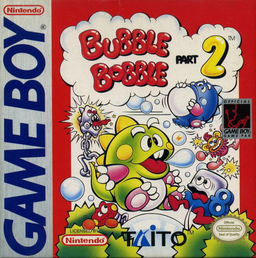
Bubble Bobble Part 2
Bubble Bobble Part 2 is a Game Boy action game released in 1993 developed by Taito. It centers on platform movement and landing judgment, story, case, or mission progress, and movement and immediate actions, with controls, information, and pacing arranged around a monochrome small screen, a directional pad, and two main action buttons.
- AI score · out of 10
- 7.1 / 10
About this game
Bubble Bobble Part 2 is a Game Boy action release centered on platform movement and landing judgment, story, case, or mission progress, and movement and immediate actions. Stages build pressure through routes, enemy patterns, and changing objectives, with progress divided into stages, tasks, matches, or growth milestones that make its immediate goals understandable. Its value depends on whether these rules continue to create judgment and room for mastery rather than on campaign length or series recognition. Short campaigns are judged by repeat-challenge value, while longer ones are judged by variety, pacing, and recovery after failure. Readable animation, hits, and hazards determine whether feedback remains dependable, while silhouettes, contrast, and audio cues need to remain clear on the monochrome display. The main genre-specific friction is that period-specific collision rules, limited guidance, and repeated ground after failure can raise the entry barrier. In addition, password or battery saves, link-cable requirements, display blur, manual dependence, and regional language can affect use of the original cartridge today. This description covers only this release and excludes emulator features, modern-port conveniences, and content from other platforms.
Recommended games
Related game recommendations on this platform
Game Boy (GB)
AI review
AI reviews are subjective assessments, not player ratings. See each review for its evidence and limitations.Published date:
A capable GB bubble sequel with opaque progression and screen limits.
Bubble Bobble Part 2 on Game Boy shares its cover and title with an NES sequel but is a separately designed handheld game, also called Bubble Bobble Junior in Japan. Trapping and popping enemies remains an inviting rule, while charged longer-range shots and a bubble that carries the hero add decisions about position and movement. Four worlds and branching areas create a substantial route. Its crucial ending condition is poorly communicated, however: collecting boss keys requires giant diamonds from earlier stages. The Game Boy version also places rooms beyond the visible screen, so players pause and scroll to locate offscreen targets, interrupting an otherwise quick action loop. Passwords soften the restart cost. Two sources differ on incidental story details; this judgment uses the exact GB play and display facts they support, not NES levels or a copied outlet grade. It suits players curious about the portable series variation.
Strengths
- Charged bubbles, branching paths and familiar trapping.
Weaknesses
- Hidden ending prerequisites and pause-to-scroll navigation.
Who it is for: Players exploring the Game Boy series branch.
Play notes: Not the NES levels; incidental story accounts conflict.
View scoring basis
| Dimension | Review state | Score | Weight |
|---|---|---|---|
| Dimension 流程丰厚而关键条件晦涩。 | Reviewed | 6.9 / 10 | Not provided |
| Dimension 经典循环有新技巧。 | Reviewed | 7.7 / 10 | Not provided |
| Dimension 亲切而新鲜感有限。 | Reviewed | 6.9 / 10 | Not provided |
| Dimension 视野限制拖慢短局节奏。 | Reviewed | 6.3 / 10 | Not provided |
Review sources
Not provided
Core information
- Developer
- Taito
- Publisher
- Taito
- Release date
- 1993
- Platforms
- Game Boy (GB)
- Content kind
- Game
- Release state
- Released
- Region
- Worldwide
- Official website
- Not provided
- Offline minimum players
- Not provided
- Offline maximum players
- Not provided
- Online minimum players
- Not provided
- Online maximum players
- Not provided
- Categories
- Action · Primary genre
- Tags
- 2D GraphicsMain Story Under 10 HoursStory-drivenReal-time CombatPlatformingSide-scrollingDodgeLinear LevelsSolo-friendlyFast-pacedReplayable
- Supported game languages
- Not provided
- Requires base game
- Not provided
- Standalone
- Not provided
- Age ratings
- Not provided
- Play modes
- Single player
- Perspectives
- Side view
Release editions
- Game Boy (GB)Worldwide1993
Game gallery
Sources
Not provided