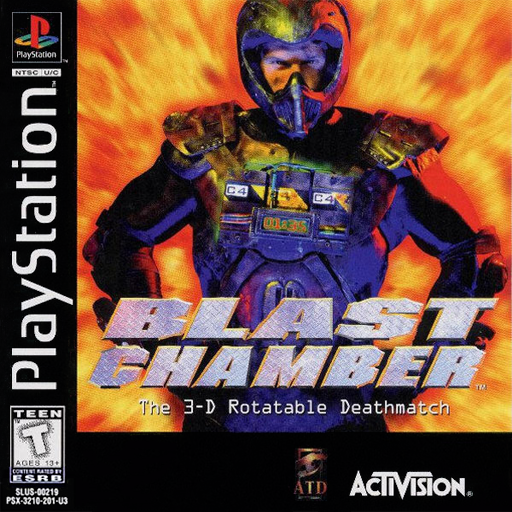
Blast Chamber
Blast Chamber is a PlayStation puzzle game released in 1996 developed by Attention To Detail. It centers on rule recognition, spatial or logical judgment, and successive puzzle solving, with controls and information arranged around the directional pad, shoulder and face buttons, plus DualShock twin analog sticks and vibration where supported.
- AI score · out of 10
- 6.1 / 10
About this game
Blast Chamber is a PlayStation puzzle game centered on rule recognition, spatial or logical judgment, and successive puzzle solving. Compact stages add conditions and tighter constraints over time, with progress divided into stages, tasks, matches, or growth milestones that make immediate goals understandable. Its value depends on whether these rules continue to create judgment and room for mastery rather than on length, sales, or series recognition. Short campaigns are judged by repeat-challenge value, while longer ones are judged by variety, pacing, and recovery after failure. Graphics, audio, and input feedback need to support decisions directly, while early 3D graphics, pre-rendered backgrounds, CD audio, and full-motion video need to preserve targets and interface readability on a television. The genre-specific limitation is that limited explanations, input recognition, repetition, or abrupt difficulty can stall progress. Platform conditions also include disc loading, Memory Card saves, regional video standards, digital or analog control support, vibration, and dedicated peripherals affect original-hardware use. This description covers only this platform release and does not import features or conveniences from remasters, emulators, or other console editions.
Recommended games
Related game recommendations on this platform
PlayStation


AI review
AI reviews are subjective assessments, not player ratings. See each review for its evidence and limitations.Published date:
An inventive rotating-cube party concept limited by visibility and retry friction.
Blast Chamber is most interesting when carrying a crystal means choosing between extending your own timer and shortening an opponent's life, then rotating the room to change everyone's position. Wall mechanisms, hazards and power-ups create sudden multiplayer reversals, while survival and death-count competitions suit short rounds. The execution is less dependable than the concept. A distant view shrinks characters, explosions lack impact, and audio atmosphere has bright spots alongside repetitive announcements. Solo challenges depend more on experimentation, with occasional corner obstruction and five-chamber save intervals magnifying recovery costs. Controller layouts, difficulty and camera options help adaptation, but cannot fully resolve visibility and precision. It is best enjoyed with friends interested in unusual party rules rather than as a smooth solo puzzle campaign. Original PS four-player play requires a Multitap, and both card saves and passwords are checkpoint-based.
Strengths
- Crystal timers and room rotation create sudden multiplayer reversals.
- Different competitive rules suit short rounds.
Weaknesses
- Poor distant visibility, imprecise actions and five-chamber saves raise solo retry costs.
Who it is for: For party players exploring unusual rules and short contests with friends.
Play notes: Original PS four-player play requires a Multitap; solo card saves and passwords are offered every five chambers.
View scoring basis
| Dimension | Review state | Score | Weight |
|---|---|---|---|
| Dimension Modes and chambers sustain short-session experimentation, while the repeated crystal loop limits lasting freshness. | Reviewed | 6.2 / 10 | Not provided |
| Dimension Timers and rotation create distinctive multiplayer tactics, while solo play relies more heavily on repeated experimentation with hazards. | Reviewed | 6.7 / 10 | Not provided |
| Dimension Music and warnings energize competition, but distant, poorly distinguished characters weaken visual appeal. | Reviewed | 5.9 / 10 | Not provided |
| Dimension Settings offer useful adjustment, but five-chamber save intervals make failed experiments expensive to recover from. | Reviewed | 4.8 / 10 | Not provided |
Review sources
Not provided
Core information
- Developer
- Attention To Detail
- Publisher
- ActivisionTec Toy
- Release date
- 1996
- Platforms
- PlayStation
- Content kind
- Game
- Release state
- Released
- Region
- Worldwide
- Official website
- Not provided
- Offline minimum players
- Not provided
- Offline maximum players
- Not provided
- Online minimum players
- Not provided
- Online maximum players
- Not provided
- Categories
- Puzzle · Primary genre
- Tags
- Pick-up and PlaySolo-friendlyReplayablePuzzle SolvingShort SessionsMain Story Under 10 HoursWarFixed Camera3D GraphicsSlow BurnLow Entry Barrier
- Supported game languages
- Not provided
- Requires base game
- Not provided
- Standalone
- Not provided
- Age ratings
- Not provided
- Play modes
- MultiplayerSingle player
- Perspectives
- Not provided
Release editions
- PlayStationWorldwide1996
Game gallery
Sources
Not provided