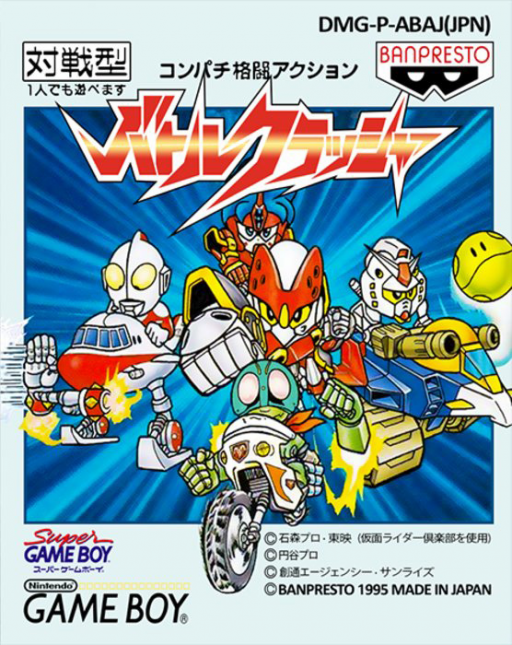
Battle Crusher
Battle Crusher is a Game Boy fighting game released in 1995 developed by Sun L. It centers on combat encounters, move inputs, and offense-defense reads, with controls, information, and pacing arranged around a monochrome small screen, a directional pad, and two main action buttons.
- AI score · out of 10
- 6.8 / 10
About this game
Battle Crusher is a Game Boy fighting release centered on combat encounters, move inputs, and offense-defense reads. Short bouts use character differences and rising difficulty for variety, with progress divided into stages, tasks, matches, or growth milestones that make its immediate goals understandable. Its value depends on whether these rules continue to create judgment and room for mastery rather than on campaign length or series recognition. Short campaigns are judged by repeat-challenge value, while longer ones are judged by variety, pacing, and recovery after failure. Animation, hit feedback, and readable arenas create match tension, while silhouettes, contrast, and audio cues need to remain clear on the monochrome display. The main genre-specific friction is that button mapping, move recognition, and cpu behavior can affect match balance. In addition, password or battery saves, link-cable requirements, display blur, manual dependence, and regional language can affect use of the original cartridge today. This description covers only this release and excludes emulator features, modern-port conveniences, and content from other platforms.
Recommended games
Related game recommendations on this platform
Game Boy (GB)
AI review
AI reviews are subjective assessments, not player ratings. See each review for its evidence and limitations.Published date:
Fighter-mount combinations appeal, but abusive tactics limit balanced exchanges.
Battle Crusher pairs crossover heroes with mounts, each contributing attacks that change ranges and fighting styles. Some arenas affect exchanges, and defeating certain opponents provides new mounts, turning progress into further choices. Readily recognizable characters preserve the crossover appeal. An eight-match, best-of-three single-player challenge has a clear endpoint. Factions change the early opponent order, but characters within one faction share it, so replay depends more on new combinations and practicing moves. Its problem is not simply having two attack buttons: abusive tactics and a CPU repeatedly launching hard-to-avoid fireballs restrict balanced exchanges. Basic attacks, jumping, crouching and pause are explicit, although combination timing still needs practice. It suits players exploring fighter-mount pairings who can tolerate opponent routines; consistently balanced, varied exchanges are a less reliable expectation.
Strengths
- Separate fighter and mount attacks, with range differences, support experimenting with different styles.
- Obtaining mounts from certain defeated enemies turns progress into additional choices.
- Readily recognizable character identities preserve the crossover's thematic appeal.
Weaknesses
- Abusive tactics and repeated CPU fireballs restrict balanced exchanges.
- Characters within a faction share the opponent order, limiting replay route variation.
Who it is for: Players who enjoy crossover heroes, experimenting with fighter-mount attacks and practicing command timing, while accepting some CPU routines and shared routes within factions.
Play notes: This covers the original Japanese 1995 Game Boy fighter. A kicks, B punches, Up jumps, Down crouches and Start pauses. Posture and mount choice change some actions. Learn basic attacks and command timing before exploring combinations; two attack buttons do not mean only punches and kicks.
View scoring basis
| Dimension | Review state | Score | Weight |
|---|---|---|---|
| Dimension Eight-match challenges, faction encounter orders and obtainable mounts provide a clear structure and rewards, with special characters adding experiments. Replay depends mainly on changing combinations and learning opponents; shared orders within each faction limit route variation. Content is basically sound but concentrates its variety in fighting choices rather than different routes. | Reviewed | 6.7 / 10 | Not provided |
| Dimension Fighter and mount attacks, different ranges and arena effects make the combination-based fighting work, with room to experiment. Abusive tactics and a CPU's repeated fireballs weaken balanced exchanges and restrict that potential. Choices are meaningful, but some encounters revolve around dealing with a dominant routine, leaving significant core limitations. | Reviewed | 6.4 / 10 | Not provided |
| Dimension Immediate character recognition is an effective visual strength: distinct familiar identities support the crossover combinations' appeal. Recognizable heroes make faction and fighter selection thematically engaging rather than simply choosing another set of attack statistics. The verified visual recognition effect provides good support for the character ensemble and paired fighting. | Reviewed | 7.2 / 10 | Not provided |
| Dimension Explicit basic inputs, posture-dependent actions and pause provide good practical support, while layered faction, fighter and mount selection organizes experimentation. Some combination timings require practice. There is an adaptation cost, but the verified functions remain useful; demanding execution is not automatically a malfunction. | Reviewed | 7.3 / 10 | Not provided |
Review sources
Not provided
Core information
- Developer
- Sun L
- Publisher
- Banpresto
- Release date
- 1995
- Platforms
- Game Boy (GB)
- Content kind
- Game
- Release state
- Released
- Region
- Worldwide
- Official website
- Not provided
- Offline minimum players
- Not provided
- Offline maximum players
- Not provided
- Online minimum players
- Not provided
- Online maximum players
- Not provided
- Categories
- Fighting · Primary genre
- Tags
- Fast-pacedReplayableShort SessionsPlayer versus PlayerSolo-friendlyReal-time Combat2D GraphicsCombosMain Story Under 10 HoursMelee Combat
- Supported game languages
- Not provided
- Requires base game
- Not provided
- Standalone
- Not provided
- Age ratings
- Not provided
- Play modes
- Single playerMultiplayer
- Perspectives
- Not provided
Release editions
- Game Boy (GB)Worldwide1995
Game gallery
Sources
Not provided