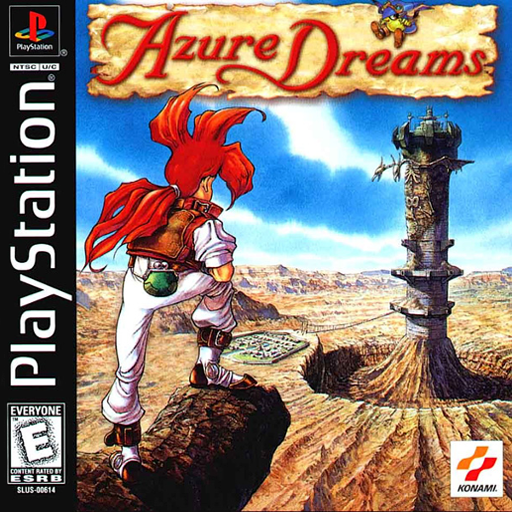
Azure Dreams
Azure Dreams is a PlayStation role-playing game released in 1997 developed by Konami. It centers on collection and development goals, area exploration, and combat and party setup, with controls and information arranged around the directional pad, shoulder and face buttons, plus DualShock twin analog sticks and vibration where supported.
- AI score · out of 10
- 7.1 / 10
About this game
Azure Dreams is a PlayStation role-playing game centered on collection and development goals, area exploration, and combat and party setup. Story beats, exploration, and progression resources support a longer campaign, with progress divided into stages, tasks, matches, or growth milestones that make immediate goals understandable. Its value depends on whether these rules continue to create judgment and room for mastery rather than on length, sales, or series recognition. Short campaigns are judged by repeat-challenge value, while longer ones are judged by variety, pacing, and recovery after failure. Characters, world building, environments, and music carry most of the atmosphere, while early 3D graphics, pre-rendered backgrounds, CD audio, and full-motion video need to preserve targets and interface readability on a television. The genre-specific limitation is that dense text, menu layers, repeated battles, loading, or language dependence can slow progress. Platform conditions also include disc loading, Memory Card saves, regional video standards, digital or analog control support, vibration, and dedicated peripherals affect original-hardware use. This description covers only this platform release and does not import features or conveniences from remasters, emulators, or other console editions.
Recommended games
Related game recommendations on this platform
PlayStation

AI review
AI reviews are subjective assessments, not player ratings. See each review for its evidence and limitations.Published date:
Monster training and tower expeditions form a distinctive loop, though shallow social systems and strict PS1 save rules require patience.
The original PlayStation Azure Dreams joins a changing monster tower, familiar training and town improvement into one long-term loop. Each expedition gathers eggs, equipment and money; the player must decide how far to push before bringing rewards home. The hero returns to a low level on the next entry, but familiars retain experience, and their elements, fusions and behavior settings reward planning across runs. Contemporary reviews disagree on how fresh the generated tower feels. One enjoys the new routes, while another finds repeated room patterns and textures quickly recognizable. Town buildings, resident events and romance choices create goals outside combat, yet these systems are lighter than their breadth first suggests. The search for the hero's father also receives relatively little attention through much of the journey. Varying musical themes and expressive dialogue portraits give the town and tower personality, offset by coarse sprites and repeated scenery. The original progress rules matter: a tower run cannot be suspended anywhere, and failure can cost carried items. That is a real session-planning burden, not a generic deduction for old hardware. This assessment concerns the PS1 game alone, without borrowing the different Game Boy Color content or modern emulator conveniences.
Strengths
- Persistent familiar growth and tactical configuration
- Tower rewards feed town improvement
- Memorable music and expressive portraits
Weaknesses
- Recognizable tower patterns despite random layouts
- Broad but shallow social and construction systems
- Restricted tower saving and punishing item loss
Who it is for: Players who enjoy monster raising, repeatable dungeon planning and self-directed progress, and can accept older failure rules.
Play notes: Original PlayStation version only. Learn its designated tower save and exit rules before a long run; the Game Boy Color version differs materially.
View scoring basis
| Dimension | Review state | Score | Weight |
|---|---|---|---|
| Dimension Monster training and town projects extend the loop, but the tower pattern recurs and social systems remain comparatively shallow. | Reviewed | 7.0 / 10 | Not provided |
| Dimension Persistent familiar growth, elemental choices and tactical movement make each tower attempt consequential despite the hero's level reset. | Reviewed | 7.6 / 10 | Not provided |
| Dimension Music and expressive portraits lend charm, while coarse sprites, repetitive tower visuals and a thin main story hold it back. | Reviewed | 6.8 / 10 | Not provided |
| Dimension Menus and combat are approachable, but designated tower save points and item loss require careful session planning. | Reviewed | 6.1 / 10 | Not provided |
Review sources
Not provided
Core information
- Developer
- Konami
- Publisher
- Konami
- Release date
- 1997
- Platforms
- PlayStation
- Content kind
- Game
- Release state
- Released
- Region
- Worldwide
- Official website
- Not provided
- Offline minimum players
- Not provided
- Offline maximum players
- Not provided
- Online minimum players
- Not provided
- Online maximum players
- Not provided
- Categories
- Role-Playing · Primary genre
- Tags
- Story-drivenCollection-richMain Story 20–50 HoursLevel ProgressionTurn-based CombatExplorationSolo-friendlyLong-term Progression3D GraphicsThird PersonFantasy
- Supported game languages
- Not provided
- Requires base game
- Not provided
- Standalone
- Not provided
- Age ratings
- Not provided
- Play modes
- Single player
- Perspectives
- Third person
Release editions
- PlayStationWorldwide1997
Game gallery
Sources
Not provided