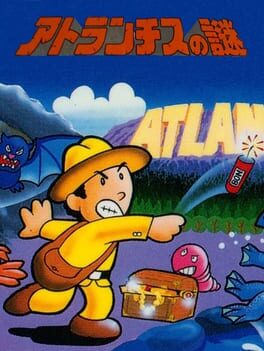
Atlantis no Nazo
Atlantis no Nazo is a Wii U action game released in 2015 developed by Sunsoft. It centers on platform movement and landing judgment, movement and immediate actions, and enemy and hazard responses, with controls, information, and pacing arranged around the GamePad touch screen, gyroscope, dual sticks, television display, and Pro Controller where supported.
- AI score · out of 10
- 6.5 / 10
About this game
Atlantis no Nazo is a Wii U action game centered on platform movement and landing judgment, movement and immediate actions, and enemy and hazard responses. Stages build pressure through routes, enemy patterns, and changing objectives, with progress divided into stages, tasks, matches, or growth milestones that make its immediate goals understandable. Its value depends on whether these rules continue to create judgment and room for mastery rather than on length, sales, or series recognition. Short campaigns are judged by repeat-challenge value, while longer ones are judged by variety, pacing, and recovery after failure. Animation, hits, camera behavior, and readable hazards determine whether feedback remains dependable, while HD television output and the GamePad screen need to divide maps, status, touch input, and primary focus clearly. The genre-specific limitation is that camera behavior, collision rules, input mapping, and repeated ground after failure can raise the entry barrier. Platform conditions also include GamePad battery life and range, shifts between two screens, loading, performance, and retired online and Miiverse services affect the current release. This description covers only this platform release and does not import features from other editions.
Recommended games
Related game recommendations on this platform
Wii U

AI review
AI reviews are subjective assessments, not player ratings. See each review for its evidence and limitations.Published date:
Discovery appeals, but harsh trial and error benefits from careful backups.
Atlantis no Nazo turns bombs, jumps and hidden exits into a nonsequential expedition. Standing and crouching alter throwing distance, enemies require different hits, and bypassing them can save time. Learning run-ups and edge adjustments creates solutions to awkward footholds. Hidden doors leading into unfamiliar zones provide the strongest attraction, while lively yet lonely melodies give the search for a missing mentor an adventurous mood. Opaque connections, abilities lost on mistakes and a particular looping death zone make progress much less consistent. Wii U whole-state backups preserve practice starting points, with interruption saving and GamePad-only play making it easier to stop and resume, but none explains hidden rules. It suits players willing to map routes, test techniques and consult guidance rather than expect every failure to teach clearly.
Strengths
- Bomb timing, enemy avoidance and jump adjustments provide learnable action choices.
- Nonsequential routes and hidden entrances give unfamiliar-zone discoveries a tangible payoff.
- Lively, lonely melodies fit solitary exploration, while Wii U backups support sectional practice.
Weaknesses
- Opaque hidden connections mean route experiments do not always provide a clear sense of progress.
- Lost abilities and a particular looping death zone make repeated attempts costly.
Who it is for: Exploration-action players willing to record zone connections, repeatedly test bombing and jumping techniques, and consult guidance when necessary.
Play notes: This covers a lawful already-held 2015 Wii U VC copy, not a promise of new purchasing. Set a whole-state backup before unknown routes. GamePad-only play requires console wireless range; this backup feature is not Switch rewind.
View scoring basis
| Dimension | Review state | Score | Weight |
|---|---|---|---|
| Dimension Nonsequential routes and hidden entrances make discovery rewarding, and learning techniques can renew motivation. The problem is not difficulty or map size itself: opaque connections, a particular death loop and lost abilities mean repeated attempts do not always build useful progress. Discovery works, but progression suffers substantial interruptions. | Reviewed | 5.6 / 10 | Not provided |
| Dimension Bomb timing, bypassing enemies and adjusting jumps create genuine learning and decisions rather than pure luck. Run-up requirements, landing slides and self-damage place a substantial burden on movement across narrow footholds. Learned techniques help, but the combined rule friction keeps the core from consistently flowing well. | Reviewed | 6.3 / 10 | Not provided |
| Dimension Lively yet slightly lonely melodies fit the search for a missing mentor across an unknown island, giving tense exploration a good emotional identity. The music retains energy while evoking the feeling of finding a way through unfamiliar places alone. Its clearest expressive value is that adventurous atmosphere rather than elaborate narrative development. | Reviewed | 7.2 / 10 | Not provided |
| Dimension Interruption saving and arbitrary-state backup provide good support for practicing sections, while GamePad-only play makes attempts easier to fit around television use. Preserving a chosen starting point reduces the cost of restarting practice. The convenience is meaningful, but players must still understand hidden routes and techniques; backup does not replace exploration. | Reviewed | 7.8 / 10 | Not provided |
Review sources
Not provided
Core information
- Developer
- Sunsoft
- Publisher
- Sunsoft
- Release date
- 2015
- Platforms
- Wii U
- Content kind
- Game
- Release state
- Released
- Region
- Worldwide
- Official website
- Not provided
- Offline minimum players
- Not provided
- Offline maximum players
- Not provided
- Online minimum players
- Not provided
- Online maximum players
- Not provided
- Categories
- Action · Primary genre
- Tags
- ReplayableThird PersonLinear LevelsReal-time CombatDodgeSolo-friendly3D GraphicsFast-pacedPlatformingMain Story Under 10 Hours
- Supported game languages
- Not provided
- Requires base game
- Not provided
- Standalone
- Not provided
- Age ratings
- Not provided
- Play modes
- Single player
- Perspectives
- Side view
Release editions
- Wii UWorldwide2015
Game gallery
Sources
Not provided