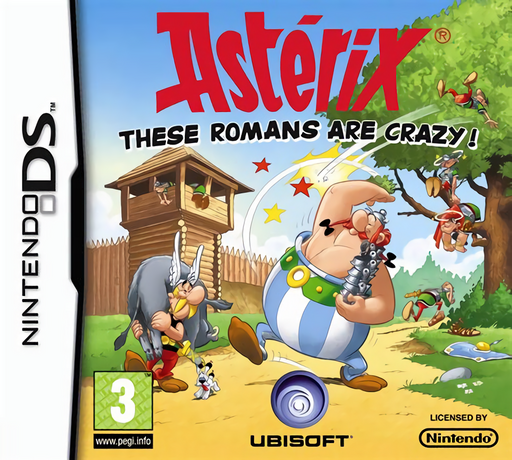
Asterix - These Romans Are Crazy!
Asterix - These Romans Are Crazy! is a Nintendo DS party and casual game released in 2009. It centers on simple rules, short objectives, and repeat challenges or social play and arranges its main commands and information around the handheld's dual screens, touch input, and physical buttons.
- AI score · out of 10
- 6.1 / 10
About this game
Asterix – These Romans are Crazy!” is going to test your reflexes. This “party game”, as the Gauls now call them, will lead you through a series of adventures via a sort of snakes and ladders game comprised of 20 mini-games that take you through four different universes: the Gaulish village the Roman camp the forest the seashore Everything it takes to thrill fans of all ages and enjoy fun with your family! The game offers a 2-player mode, playing by turns on the same Nintendo DS. In this Nintendo DS release, simple rules, short objectives, and repeat challenges or social play form the main playable structure. Mini-games and short rounds make repeated play easy to start. The dual screens, stylus, and buttons divide commands from status information where the design calls for it. Bold characters, clear prompts, and light audio support social play, while solo depth is often limited, and multiplayer may require extra hardware. This description applies to the Nintendo DS edition and does not import modes, presentation upgrades, or convenience features from home-console versions, mobile adaptations, later ports, or remakes.
Recommended games
Related game recommendations on this platform
Nintendo DS

AI review
AI reviews are subjective assessments, not player ratings. See each review for its evidence and limitations.Published date:
基本成立 Nintendo DS party and casual experience
Asterix - These Romans Are Crazy! centers on simple rules, short objectives, and repeat challenges or social play. Mini-games and short rounds make repeated play easy to start, giving the Nintendo DS release recognizable goals and a coherent portable rhythm. Bold characters, clear prompts, and light audio support social play. Its value comes from how the main rules work with the handheld interface, while variety and room for mastery determine the longer-term appeal. Solo depth is often limited, and multiplayer may require extra hardware, which is the principal limitation on original hardware. GameNavo scores this concrete release across four independently judged dimensions and does not use press aggregates, user ratings, source length, media count, title recognition, or features from another platform.
Strengths
- simple rules, and short objectives provide a readable mechanical foundation.
- Progress is divided into understandable stages, tasks, matches, or chapters.
- Presentation and interface feedback support the main rules.
Weaknesses
- Solo depth is often limited, and multiplayer may require extra hardware.
- Original language, multiplayer hardware, or touch conditions may affect present-day use.
Who it is for: Players who enjoy party and casual games, accept Nintendo DS-era interface conventions, and want to assess the original handheld release on its own terms.
Play notes: This review covers the Nintendo DS release without emulator save states, speed-up, or later-port features and does not represent a complete playthrough.
View scoring basis
| Dimension | Review state | Score | Weight |
|---|---|---|---|
| Dimension Mini-games and short rounds make repeated play easy to start. The 6.2 score weighs variety, repetition, difficulty progression, recovery after failure, and replay value rather than nominal length or source volume. | Reviewed | 6.2 / 10 | Not provided |
| Dimension The core loop is assessed through simple rules, short objectives, and repeat challenges or social play, including rule depth, control feedback, and room for mastery. The 5.9 score applies to this DS release and excludes title recognition and external ratings. | Reviewed | 5.9 / 10 | Not provided |
| Dimension Bold characters, clear prompts, and light audio support social play. The 6.2 score judges art, sound, interface, dual-screen use, and touch presentation against Nintendo DS-era conditions. | Reviewed | 6.2 / 10 | Not provided |
| Dimension Solo depth is often limited, and multiplayer may require extra hardware. The 6.1 score covers original-hardware response, information clarity, saving, language, and accessory requirements without emulator conveniences. | Reviewed | 6.1 / 10 | Not provided |
Review sources
Not provided
Core information
- Developer
- Ubisoft
- Publisher
- Ubisoft
- Release date
- 2009
- Platforms
- Nintendo DS
- Content kind
- Game
- Release state
- Released
- Region
- Worldwide
- Official website
- Not provided
- Offline minimum players
- Not provided
- Offline maximum players
- Not provided
- Online minimum players
- Not provided
- Online maximum players
- Not provided
- Categories
- Party · Primary genre
- Tags
- Solo-friendlyShort SessionsTop-downReplayablePick-up and PlayLow Entry BarrierPlayer versus PlayerBoard and Tabletop PlayParty-friendly
- Supported game languages
- Not provided
- Requires base game
- Not provided
- Standalone
- Not provided
- Age ratings
- Not provided
- Play modes
- Single playerMultiplayer
- Perspectives
- Top-down
Release editions
- Nintendo DSWorldwide2009
Game gallery
Sources
Not provided