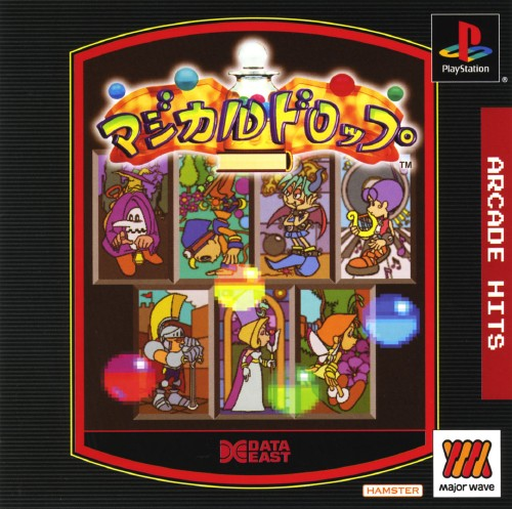
Arcade Hits - Magical Drop
Arcade Hits - Magical Drop is a PlayStation puzzle game released in 2002 developed by Data East Corporation. It centers on puzzle, maze, or device solving, card or board-game rules, and rule recognition, with controls and information arranged around the directional pad, shoulder and face buttons, plus DualShock twin analog sticks and vibration where supported.
- AI score · out of 10
- 7.4 / 10
About this game
Arcade Hits - Magical Drop is a PlayStation puzzle game centered on puzzle, maze, or device solving, card or board-game rules, and rule recognition. Compact stages add conditions and tighter constraints over time, with progress divided into stages, tasks, matches, or growth milestones that make immediate goals understandable. Its value depends on whether these rules continue to create judgment and room for mastery rather than on length, sales, or series recognition. Short campaigns are judged by repeat-challenge value, while longer ones are judged by variety, pacing, and recovery after failure. Graphics, audio, and input feedback need to support decisions directly, while early 3D graphics, pre-rendered backgrounds, CD audio, and full-motion video need to preserve targets and interface readability on a television. The genre-specific limitation is that limited explanations, input recognition, repetition, or abrupt difficulty can stall progress. Platform conditions also include disc loading, Memory Card saves, regional video standards, digital or analog control support, vibration, and dedicated peripherals affect original-hardware use. This description covers only this platform release and does not import features or conveniences from remasters, emulators, or other console editions.
Recommended games
Related game recommendations on this platform
PlayStation

AI review
AI reviews are subjective assessments, not player ratings. See each review for its evidence and limitations.Published date:
Active chains reward practice, with varied goals and a learning barrier.
This Magical Drop makes clearing an active attack. Moving between columns, grabbing matching drops and throwing them back links field management with extending a chain. The few actions leave room for repeated practice and changing decisions. Computer battles, survival scoring and move-limited puzzles give those rules different objectives; the puzzles change the pace but are demanding from the start. Colourful characters and synthetic instrumentation establish a recognizable style, although rough forms and limited animation weaken expression. Straightforward action buttons and pausing make basic use practical, while sparse system and mode explanations make preparation worthwhile. It is best approached as a puzzle game to learn and revisit, rather than an effortless diversion. Players willing to study the rules can enjoy steadily expanding their command of the field.
Strengths
- Active chains connect grabbing and throwing with field planning.
- Battles, survival and move-limited puzzles offer different challenge objectives.
- Paired action buttons and pausing make basic controls compact.
Weaknesses
- Sparse system and mode explanations increase initial discovery costs.
- Demanding early puzzles make the introduction less gradual.
- Rough forms and limited animation weaken character expression.
Who it is for: Puzzle players who enjoy active clearing, opponent pressure and move-limited planning, and are willing to learn the rules before repeated practice.
Play notes: This assessment covers Japanese PS1 disc SLPM-87173 with Japanese menus, not III or F or later emulator conveniences. Save/recovery behaviour and current hardware execution were not verified.
View scoring basis
| Dimension | Review state | Score | Weight |
|---|---|---|---|
| Dimension Battles, survival and move-limited solutions change the objective and pace of thought, producing good replay structure around the same rules. The puzzles are not an easy transition: demanding early problems make the introduction less gradual despite the meaningful variety. | Reviewed | 7.5 / 10 | Not provided |
| Dimension Grabbing, changing columns and returning drops tightly connect field management with extending an attack. A small action set produces excellent immediate decision density. Its value lies in coordinating arrangement and timing through active chains, not simply in moving fast. | Reviewed | 8.2 / 10 | Not provided |
| Dimension Strong colour and synthetic instrumentation establish a recognizable style. Presentation is basically effective, but rough forms and limited animation restrict character vitality. The judgment concerns modelling and movement, not the age of the game or an automatic objection to synthetic music. | Reviewed | 6.2 / 10 | Not provided |
| Dimension Directional movement, paired grab/drop buttons and pausing make basic operation practical. Sparse system and mode explanations still impose discovery costs, leaving usability basically effective rather than fully approachable. Japanese is the normal condition of this original Japanese release, not a translation fault. | Reviewed | 6.8 / 10 | Not provided |
Review sources
Not provided
Core information
- Developer
- Data East
- Publisher
- HAMSTER
- Release date
- 2002
- Platforms
- PlayStation
- Content kind
- Game
- Release state
- Released
- Region
- Worldwide
- Official website
- Not provided
- Offline minimum players
- Not provided
- Offline maximum players
- Not provided
- Online minimum players
- Not provided
- Online maximum players
- Not provided
- Categories
- Puzzle · Primary genre
- Tags
- Puzzle SolvingCard PlayFantasyBoard and Tabletop PlayShort Sessions3D Graphics
- Supported game languages
- Not provided
- Requires base game
- Not provided
- Standalone
- Not provided
- Age ratings
- Not provided
- Play modes
- Not provided
- Perspectives
- Not provided
Release editions
- PlayStationWorldwide2002
Game gallery
Sources
Not provided