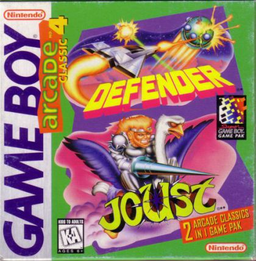
Arcade Classic No. 4 - Defender & Joust
Arcade Classic No. 4 - Defender _ Joust is a Game Boy shooter game released in 1995 developed by Williams Entertainment. It centers on local connection or multiplayer interaction, shooting and weapon management, and positioning and evasion, with controls, information, and pacing arranged around a monochrome small screen, a directional pad, and two main action buttons.
- AI score · out of 10
- 6.6 / 10
About this game
Arcade Classic No. 4 - Defender _ Joust is a Game Boy shooter release centered on local connection or multiplayer interaction, shooting and weapon management, and positioning and evasion. Missions pace progress through enemy waves, routes, and weapon opportunities, with progress divided into stages, tasks, matches, or growth milestones that make its immediate goals understandable. Its value depends on whether these rules continue to create judgment and room for mastery rather than on campaign length or series recognition. Short campaigns are judged by repeat-challenge value, while longer ones are judged by variety, pacing, and recovery after failure. Projectiles, hits, and danger zones must remain readable within the available display, while silhouettes, contrast, and audio cues need to remain clear on the monochrome display. The main genre-specific friction is that dense encounters, limited visibility, and continue costs amplify reaction and memorization pressure. In addition, password or battery saves, link-cable requirements, display blur, manual dependence, and regional language can affect use of the original cartridge today. This description covers only this release and excludes emulator features, modern-port conveniences, and content from other platforms.
Recommended games
Related game recommendations on this platform
Game Boy (GB)

AI review
AI reviews are subjective assessments, not player ratings. See each review for its evidence and limitations.Published date:
Rescue and height-based collisions retain clear risk strategies, but display clarity makes execution less comfortable.
Defender and Joust preserve two different kinds of pressure on Game Boy. Defender asks players to stop abductors and catch people falling after their captors are destroyed. Shooting, rescue and escape compete for attention, while scarce smart bombs make emergencies consequential. Joust instead builds collisions around height. Flapping, inertia and recoil determine the next approach; faster button presses do not guarantee victory. Both structures support short-session practice, but reading the action takes effort. Busy Defender scenes make enemies and projectiles difficult to identify. Joust's alternative views can reduce the visible field and conceal approaching threats. Added background music, Defender background inversion and Joust viewing options provide useful adjustments without resolving every visibility problem. The package retains distinct risk-based pleasures, particularly for players prepared to learn weighted movement and tolerate visual uncertainty while improving.
Strengths
- Captive rescue and height contests create different risk decisions.
- Music, background inversion and viewing options provide practical presentation choices.
Weaknesses
- Busy Defender scenes obscure enemies and captives; reduced Joust views make offscreen threats harder to anticipate.
Who it is for: For score chasers willing to learn inertia and rescue-related risks.
Play notes: This evaluates the Game Boy pair without Super Game Boy borders or colour modes. Joust's inertia is part of its rules; zoomed views reduce the visible playfield.
View scoring basis
| Dimension | Review state | Score | Weight |
|---|---|---|---|
| Dimension Different rhythms and views support repeated practice, with development centered on mastering rules rather than new objectives. | Reviewed | 6.6 / 10 | Not provided |
| Dimension Rescue versus shooting and height versus inertia create clear trade-offs with retained skill depth. | Reviewed | 7.2 / 10 | Not provided |
| Dimension Added music supports rhythm, while actual motion clarity and view trade-offs limit readability, not monochrome itself. | Reviewed | 6.1 / 10 | Not provided |
| Dimension Simplified movement and display options help, but quick targets and restricted views complicate anticipation; inertia is not treated as a malfunction. | Reviewed | 5.5 / 10 | Not provided |
Review sources
Not provided
Core information
- Developer
- Williams
- Publisher
- NintendoMidwayDigital Eclipse
- Release date
- 1995
- Platforms
- Game Boy (GB)
- Content kind
- Compilation
- Release state
- Released
- Region
- Worldwide
- Official website
- Not provided
- Offline minimum players
- Not provided
- Offline maximum players
- Not provided
- Online minimum players
- Not provided
- Online maximum players
- Not provided
- Categories
- Shooter · Primary genreAction
- Tags
- ShootingReplayableFast-pacedSolo-friendlySide-scrollingPlayer versus Player2D GraphicsLinear LevelsMain Story Under 10 HoursPlayer versus EnvironmentDodgeLocal Co-op
- Supported game languages
- Not provided
- Requires base game
- Not provided
- Standalone
- Not provided
- Age ratings
- Not provided
- Play modes
- Single player
- Perspectives
- Side view
Release editions
- Game Boy (GB)Worldwide1995
Game gallery
Sources
Not provided