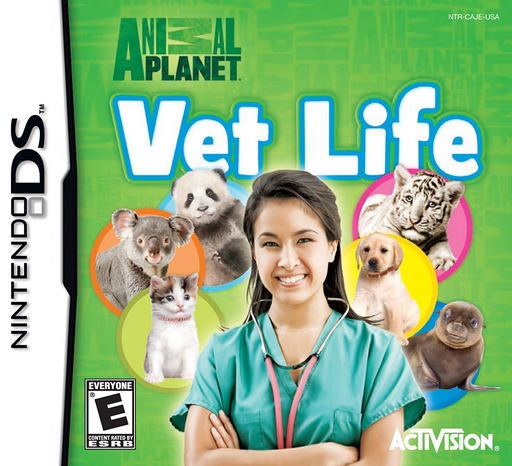
Animal Planet - Vet Life
Animal Planet - Vet Life is a Nintendo DS simulation game released in 2009. It centers on area exploration, music, rhythm, and performance, and state management and arranges its main commands and information around the handheld's dual screens, touch input, and physical buttons.
- AI score · out of 10
- 6.5 / 10
About this game
Journey across the globe and become a world-renowned veterinary doctor. Take on the role of either Jack or Abani, young vets working under the guidance of Dr. Rogers. Volunteer at local vet clinics across the world and treat a variety of different animals in different settings. In this Nintendo DS release, area exploration, music, rhythm, and performance, and state management form the main playable structure. Changing values, schedules, or staged goals encourage repeated adjustment. The dual screens, stylus, and buttons divide commands from status information where the design calls for it. Interface clarity and state feedback matter more than spectacle, while limited explanations, dense menus, or real-time dependencies can increase friction. This description applies to the Nintendo DS edition and does not import modes, presentation upgrades, or convenience features from home-console versions, mobile adaptations, later ports, or remakes.
Collected in series
Animal Planet’s licensed games turn an interest in animals into hands-on activities. Veterinary adventures focus on caring for patients, while children’s apps invite players to find pets and explore animal-themed games.
Recommended games
Related game recommendations on this platform
Nintendo DS
AI review
AI reviews are subjective assessments, not player ratings. See each review for its evidence and limitations.Published date:
基本成立 Nintendo DS simulation experience
Animal Planet - Vet Life centers on area exploration, music, rhythm, and performance, and state management. Changing values, schedules, or staged goals encourage repeated adjustment, giving the Nintendo DS release recognizable goals and a coherent portable rhythm. Interface clarity and state feedback matter more than spectacle. Its value comes from how the main rules work with the handheld interface, while variety and room for mastery determine the longer-term appeal. Limited explanations, dense menus, or real-time dependencies can increase friction, which is the principal limitation on original hardware. GameNavo scores this concrete release across four independently judged dimensions and does not use press aggregates, user ratings, source length, media count, title recognition, or features from another platform.
Strengths
- area exploration, and music, rhythm, and performance provide a readable mechanical foundation.
- Progress is divided into understandable stages, tasks, matches, or chapters.
- Presentation and interface feedback support the main rules.
Weaknesses
- Limited explanations, dense menus, or real-time dependencies can increase friction.
- Original language, multiplayer hardware, or touch conditions may affect present-day use.
Who it is for: Players who enjoy simulation games, accept Nintendo DS-era interface conventions, and want to assess the original handheld release on its own terms.
Play notes: This review covers the Nintendo DS release without emulator save states, speed-up, or later-port features and does not represent a complete playthrough.
View scoring basis
| Dimension | Review state | Score | Weight |
|---|---|---|---|
| Dimension Changing values, schedules, or staged goals encourage repeated adjustment. The 6.4 score weighs variety, repetition, difficulty progression, recovery after failure, and replay value rather than nominal length or source volume. | Reviewed | 6.4 / 10 | Not provided |
| Dimension The core loop is assessed through area exploration, music, rhythm, and performance, and state management, including rule depth, control feedback, and room for mastery. The 6.5 score applies to this DS release and excludes title recognition and external ratings. | Reviewed | 6.5 / 10 | Not provided |
| Dimension Interface clarity and state feedback matter more than spectacle. The 6.8 score judges art, sound, interface, dual-screen use, and touch presentation against Nintendo DS-era conditions. | Reviewed | 6.8 / 10 | Not provided |
| Dimension Limited explanations, dense menus, or real-time dependencies can increase friction. The 6.3 score covers original-hardware response, information clarity, saving, language, and accessory requirements without emulator conveniences. | Reviewed | 6.3 / 10 | Not provided |
Review sources
Not provided
Core information
- Developer
- Big Blue Bubble
- Publisher
- Activision
- Release date
- 2009
- Platforms
- Nintendo DS
- Content kind
- Game
- Release state
- Released
- Region
- Worldwide
- Official website
- Not provided
- Offline minimum players
- Not provided
- Offline maximum players
- Not provided
- Online minimum players
- Not provided
- Online maximum players
- Not provided
- Categories
- Simulation · Primary genre
- Tags
- 2D GraphicsSolo-friendlyExplorationReplayableLong-term ProgressionMusic PerformanceSlow BurnCozyTop-downRhythm-based PlayLife SimulationResource Management
- Supported game languages
- Not provided
- Requires base game
- Not provided
- Standalone
- Not provided
- Age ratings
- Not provided
- Play modes
- Single player
- Perspectives
- First person
Release editions
- Nintendo DSWorldwide2009
- WiiWorldwide2009
Game gallery
Sources
Not provided