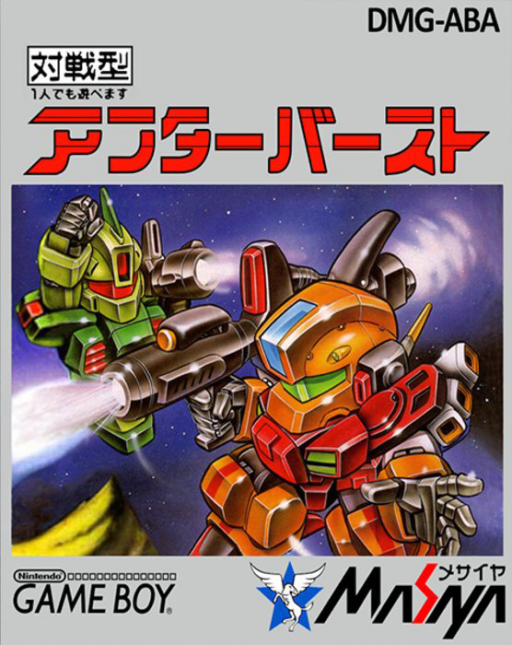
After Burst
After Burst is a Game Boy puzzle game released in 1990 developed by Dual Corporation. It centers on puzzle, maze, or device solving, rule recognition, and spatial or logical judgment, with controls, information, and pacing arranged around a monochrome small screen, a directional pad, and two main action buttons.
- AI score · out of 10
- 7.0 / 10
About this game
After Burst is a Game Boy puzzle release centered on puzzle, maze, or device solving, rule recognition, and spatial or logical judgment. Compact stages add conditions and tighter constraints over time, with progress divided into stages, tasks, matches, or growth milestones that make its immediate goals understandable. Its value depends on whether these rules continue to create judgment and room for mastery rather than on campaign length or series recognition. Short campaigns are judged by repeat-challenge value, while longer ones are judged by variety, pacing, and recovery after failure. Graphics, audio cues, and state feedback need to support decisions directly, while silhouettes, contrast, and audio cues need to remain clear on the monochrome display. The main genre-specific friction is that limited explanations, repetition, or abrupt difficulty can stall progress. In addition, password or battery saves, link-cable requirements, display blur, manual dependence, and regional language can affect use of the original cartridge today. This description covers only this release and excludes emulator features, modern-port conveniences, and content from other platforms.
Recommended games
Related game recommendations on this platform
Game Boy (GB)
AI review
AI reviews are subjective assessments, not player ratings. See each review for its evidence and limitations.Published date:
Clever single-screen shot puzzles reward thought, though weak versus play and slowdown limit the package.
Japan's original Game Boy After Burst is not an After Burner-style flight shooter. It turns powered-suit shooting into compact, timed puzzles: adjust the cannon angle and charge a shot to change its path, then destroy a core. Breaking blocks in the wrong order or eliminating an enemy needed as a platform can trap the player, so a carefully planned arc feels rewarding. Thirty stages, bosses every ten and passwords every five give the campaign a clear portable rhythm. The overall supply is modest, however, and the random-block versus mode emphasizes combat without matching the main game's puzzle appeal. Sparse story and simple monochrome presentation are functional rather than memorable, but a deliberate single-screen pace remains legible on the original Game Boy display. A completed-cartridge account reports noticeable native slowdown in busy scenes, especially versus. The title is most worthwhile for its blend of aiming and spatial reasoning, not for high-speed action or extensive extras. This rating concerns the 1990 Japan-only Game Boy cartridge, not a similarly named title or altered emulation.
Strengths
- Angle and charge turn shots into distinctive spatial puzzles.
- Block order and enemies-as-platforms reward planning.
- Passwords every five levels support portable progress.
Weaknesses
- The 30-stage campaign is limited and versus is less engaging.
- Busy original-hardware scenes slow down, particularly versus.
- Story and audiovisual wrapping remain simple.
Who it is for: Retro handheld players who enjoy compact mechanisms and precise aiming.
Play notes: Wrong destruction choices can dead-end a stage; this is unrelated to After Burner.
View scoring basis
| Dimension | Review state | Score | Weight |
|---|---|---|---|
| Dimension Thirty puzzles and periodic passwords structure a good handheld campaign, but versus is thinner. | Reviewed | 6.7 / 10 | Not provided |
| Dimension Aiming arcs and destruction order make compact screens into rewarding action puzzles. | Reviewed | 8.0 / 10 | Not provided |
| Dimension Readable single screens suit the old LCD, while narrative and audiovisual identity remain spare. | Reviewed | 6.0 / 10 | Not provided |
| Dimension Precise charge-and-angle control survives noticeable native slowdown in busier scenes. | Reviewed | 6.0 / 10 | Not provided |
Review sources
Not provided
Core information
- Developer
- Dual
- Publisher
- Masaya
- Release date
- 1990
- Platforms
- Game Boy (GB)
- Content kind
- Game
- Release state
- Released
- Region
- Worldwide
- Official website
- Not provided
- Offline minimum players
- Not provided
- Offline maximum players
- Not provided
- Online minimum players
- Not provided
- Online maximum players
- Not provided
- Categories
- Puzzle · Primary genre
- Tags
- ReplayableMain Story Under 10 Hours2D GraphicsSlow BurnPuzzle SolvingScience FictionFixed CameraLow Entry BarrierShort SessionsPick-up and PlaySolo-friendlyWar
- Supported game languages
- Not provided
- Requires base game
- Not provided
- Standalone
- Not provided
- Age ratings
- Not provided
- Play modes
- Single player
- Perspectives
- Not provided
Release editions
- Game Boy (GB)Worldwide1990
Game gallery
Sources
Not provided