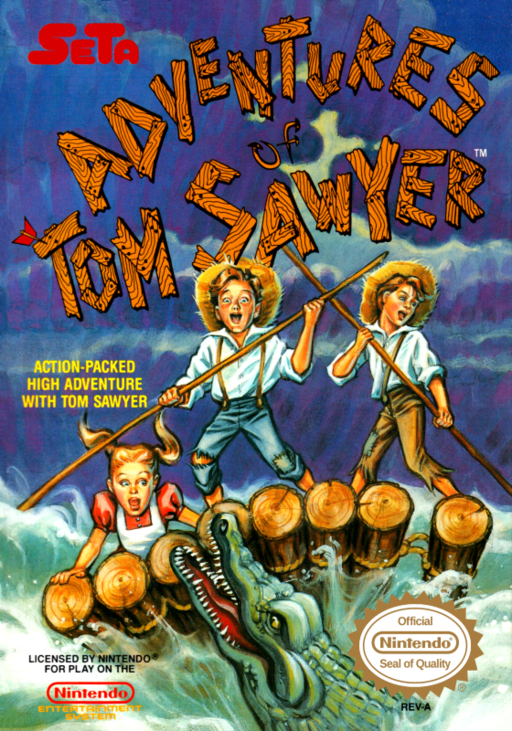
Adventures of Tom Sawyer
Adventures of Tom Sawyer is a platformer game released for the Nintendo Entertainment System in 1989. The storyline does not directly portray the book written by Mark Twain. However, the characters in the game are the same as in the book. Control in this typical platform game consists of jumping and throwing rocks. Players must avoid many obstacles, such as rolling barrels, and defeat persistent enemies, such as pirates, mice, and even a giant octopus. The level order has been changed in the English version (perhaps to avoid confusing players by starting with the rafting stage). The Japanese original's level 5, the pirate ship, is the English version's level 1, making the beginning of the game much more difficult and the plot non-cohesive.
- AI score · out of 10
- 5.6 / 10
About this game
Adventures of Tom Sawyer is a platformer game released for the Nintendo Entertainment System in 1989. The storyline does not directly portray the book written by Mark Twain. However, the characters in the game are the same as in the book. Control in this typical platform game consists of jumping and throwing rocks. Players must avoid many obstacles, such as rolling barrels, and defeat persistent enemies, such as pirates, mice, and even a giant octopus. The level order has been changed in the English version (perhaps to avoid confusing players by starting with the rafting stage). The Japanese original's level 5, the pirate ship, is the English version's level 1, making the beginning of the game much more difficult and the plot non-cohesive.
Recommended games
Related game recommendations on this platform
Famicom / NES
AI review
AI reviews are subjective assessments, not player ratings. See each review for its evidence and limitations.Published date:
Adventures of Tom Sawyer is assessed here as a specific FC/NES release with its documented strengths and practical limits kept in view.
Adventures of Tom Sawyer is a platformer game released for the Nintendo Entertainment System in 1989. The storyline does not directly portray the book written by Mark Twain. However, the characters in the game are the same as in the book. Control in this typical platform game consists of jumping and throwing rocks. Players must avoid many obstacles, such as rolling barrels, and defeat persistent enemies, such as pirates, mice, and even a giant octopus. The level order has been changed in the English version (perhaps to avoid confusing players by starting with the rafting stage). The Japanese original's level 5, the pirate ship, is This assessment focuses on the specific FC or NES release and on the play actions, goals, and progression documented for Adventures of Tom Sawyer. Its value comes from how clearly the central rules create decisions and feedback across a session. Pacing is judged by the variety of situations, the learning curve, recovery after failure, and the reason to replay. Presentation is considered through readability, animation, sound, and the consistency of the game's style rather than by modern resolution. Practical limits such as period controls, guidance, saving, or required accessories are included only when they affect this release. Players who enjoy learning compact systems and improving through repeated attempts are the clearest audience, while anyone seeking
Strengths
- The documented central loop gives Adventures of Tom Sawyer a clear identity and a learnable set of goals.
- Progress rewards understanding the rules and applying them more consistently across repeated situations.
Weaknesses
- The original release can create friction through its documented difficulty, guidance, control, or recovery limits.
Who it is for: Players interested in the original FC/NES design and willing to learn its period-specific rules.
Play notes: Check the documented language, saving, accessory, and recovery conditions for this exact release.
View scoring basis
| Dimension | Review state | Score | Weight |
|---|---|---|---|
| Dimension The content pacing score applies the V3 boundary to the documented mechanics, pacing, presentation, and FC release constraints. | Reviewed | 4.9 / 10 | Not provided |
| Dimension The core experience score applies the V3 boundary to the documented mechanics, pacing, presentation, and FC release constraints. | Reviewed | 5.3 / 10 | Not provided |
| Dimension The presentation immersion score applies the V3 boundary to the documented mechanics, pacing, presentation, and FC release constraints. | Reviewed | 7.3 / 10 | Not provided |
| Dimension The technical usability score applies the V3 boundary to the documented mechanics, pacing, presentation, and FC release constraints. | Reviewed | 5.0 / 10 | Not provided |
Review sources
Not provided
Core information
- Developer
- SETA
- Publisher
- SETA
- Release date
- 1989
- Platforms
- Famicom / NES
- Content kind
- Game
- Release state
- Released
- Region
- Worldwide
- Official website
- Not provided
- Offline minimum players
- Not provided
- Offline maximum players
- Not provided
- Online minimum players
- Not provided
- Online maximum players
- Not provided
- Categories
- Action · Primary genre
- Tags
- ShootingFast-pacedParty-friendlyRetro StyleFamily-friendlySolo-friendly2D GraphicsTop-downPlatformingSide-scrollingPixel ArtHistorical
- Supported game languages
- Not provided
- Requires base game
- Not provided
- Standalone
- Not provided
- Age ratings
- Not provided
- Play modes
- Co-opSingle playerMultiplayer
- Perspectives
- Side viewIsometricTop-down
Release editions
- Famicom / NESWorldwide1989
Game gallery
Sources
Not provided