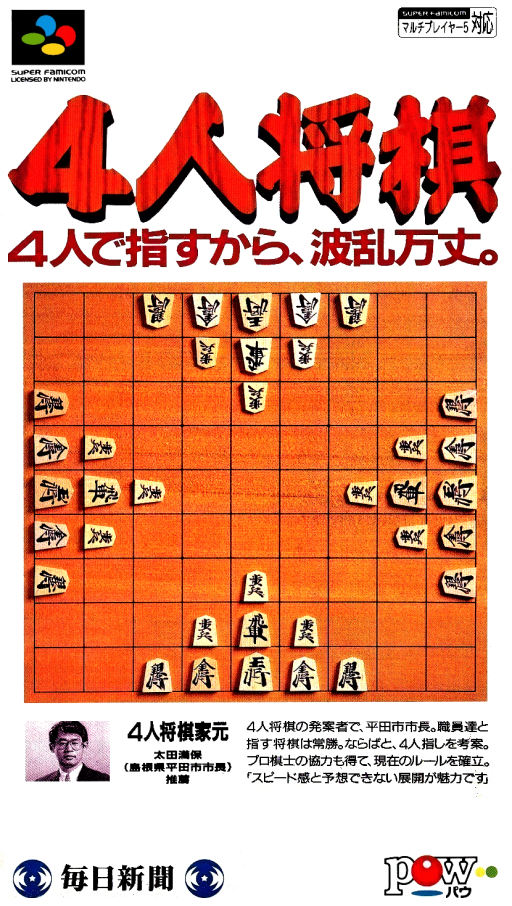
4-nin Shougi
4-nin Shougi is a Super Famicom card and board game released in 1995 developed by Pow. It centers on card or board-game rules, local connection or multiplayer interaction, and rules interaction, with controls, information, and pacing arranged around television output, a directional pad, shoulder buttons, and a six-button controller.
- AI score · out of 10
- 7.2 / 10
About this game
4-nin Shougi is a Super Famicom card and board release centered on card or board-game rules, local connection or multiplayer interaction, and rules interaction. Matches, decks, or board objectives create a repeatable strategy loop, with progress divided into stages, tasks, matches, or growth milestones that make its immediate goals understandable. Its value depends on whether these rules continue to create judgment and room for mastery rather than on campaign length or series recognition. Short campaigns are judged by repeat-challenge value, while longer ones are judged by variety, pacing, and recovery after failure. Card, board, and state readability determine usability, while sprite animation, scrolling, color, and chip-based audio jointly carry readability and atmosphere. The main genre-specific friction is that rules terminology, opponent pacing, and text density raise the entry barrier. In addition, password or battery saves, multiplayer accessories, manual dependence, regional language, and cartridge enhancement chips can affect original-hardware use. This description covers only this release and excludes emulator features, modern-port conveniences, and content from other platforms.
Recommended games
Related game recommendations on this platform
Super Famicom / SNES

AI review
AI reviews are subjective assessments, not player ratings. See each review for its evidence and limitations.Published date:
Four-sided shogi offers real strategic novelty, though cautious computer play slows the match.
4 Nin Shougi on Super Famicom is more than ordinary shogi with extra opponents. Four sides face one another, and mating an opponent transfers that player's board and hand pieces to the attacker. A position can therefore swing suddenly, while every advance must account for threats from more than one direction. Choosing whom to attack and when to leave resources in reserve gives the variant a distinct strategic appeal. Computer-controlled rivals mean that a solo player can try a tabletop game that would otherwise need a group. Colourful boards and varied character portraits make the abstraction approachable. The cost is a learning barrier: basic shogi piece movement is still assumed, and this version has further special rules. A direct review describes a defensive computer and matches that can run long. Most replay value comes from the changing positions rather than a broad set of unrelated modes. Rotating the board is a useful console convenience, but the optional soldier-piece art can be harder to identify than normal symbols, and the music repeats during extended games. This appraisal concerns the 1995 Japanese SFC cartridge. Sources differ on simultaneous human-controller capacity, so four board seats should not be taken as a verified promise of four local human players. It is rewarding for someone who already knows shogi and enjoys multi-party tactics.
Strengths
- Four fronts and captured armies make alliances and attack timing matter
- CPU rivals let a single player explore the unusual rules
- Board rotation and characterful visuals make the format approachable
Weaknesses
- Defensive computer play can make sessions overlong
- Optional soldier sprites are harder to read; music repeats
- Extra rules and Japanese text demand preparation
Who it is for: Players familiar with shogi moves who enjoy lengthy, multi-sided abstract strategy.
Play notes: Japanese 1995 SFC cartridge only. Four seats do not establish four simultaneous human controllers; learn the variant rules before play.
View scoring basis
| Dimension | Review state | Score | Weight |
|---|---|---|---|
| Dimension Solo CPU play makes the variant accessible, but defensive AI can stretch already deliberate matches. | Reviewed | 7.1 / 10 | Not provided |
| Dimension Four fronts and absorbing a mated army create genuine tactical shifts, assuming basic shogi knowledge. | Reviewed | 7.7 / 10 | Not provided |
| Dimension Colour and character portraits help; soldier-piece art obscures identity and looping music wears thin. | Reviewed | 6.7 / 10 | Not provided |
| Dimension Board rotation and simple inputs help, while Japanese text and extra rules raise the entry barrier. | Reviewed | 6.9 / 10 | Not provided |
Review sources
Not provided
Core information
- Developer
- Pow
- Publisher
- Pow
- Release date
- 1995
- Platforms
- Super Famicom / SNES
- Content kind
- Game
- Release state
- Released
- Region
- Worldwide
- Official website
- Not provided
- Offline minimum players
- Not provided
- Offline maximum players
- Not provided
- Online minimum players
- Not provided
- Online maximum players
- Not provided
- Categories
- Card & Tabletop · Primary genre
- Tags
- Card Play2D GraphicsTurn-based TacticsBoard and Tabletop PlaySlow BurnPlayer versus Player
- Supported game languages
- Not provided
- Requires base game
- Not provided
- Standalone
- Not provided
- Age ratings
- Not provided
- Play modes
- Not provided
- Perspectives
- Not provided
Release editions
- Super Famicom / SNESWorldwide1995
Game gallery
Sources
Not provided