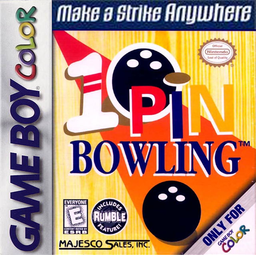
10-Pin Bowling
10-Pin Bowling is a Game Boy Color sports game released in 1999 developed by Morning Star Multimedia. It centers on competitive sport play, sport controls, and shifts between attack and defense, with controls, information, and pacing arranged around a color handheld screen, a directional pad, and two main action buttons.
- AI score · out of 10
- 5.9 / 10
About this game
10-Pin Bowling is a Game Boy Color sports release centered on competitive sport play, sport controls, and shifts between attack and defense. Matches, challenges, and tournament goals give sessions clear boundaries, with progress divided into stages, tasks, matches, or growth milestones that make its immediate goals understandable. Its value depends on whether these rules continue to create judgment and room for mastery rather than on campaign length or series recognition. Short campaigns are judged by repeat-challenge value, while longer ones are judged by variety, pacing, and recovery after failure. Players, venues, and score feedback establish the match atmosphere, while color choices need to distinguish characters, objects, and routes rather than serve as decoration alone. The main genre-specific friction is that opponent ai, control precision, and period-specific rosters can affect consistency. In addition, battery saves, link cables, cartridge-specific hardware, the unlit display, and regional language can affect the original experience. This description covers only this release and excludes emulator features, modern-port conveniences, and content from other platforms.
Recommended games
Related game recommendations on this platform
Game Boy Color (GBC)
AI review
AI reviews are subjective assessments, not player ratings. See each review for its evidence and limitations.Published date:
A functional portable bowling game with thin long-term variety.
Game Boy Color 10-Pin Bowling condenses starting position, power and curve into a few controls. The result of one throw can inform the next adjustment. Its value depends on clear bowling decisions, not on the amount of detail an old handheld could display. Positioning, holding A, adjusting spin and power, then releasing within the meter creates a clear sequence of choices. The written guide cannot establish how satisfying collisions feel. Full games, alternating two-player turns and frame-by-frame scores preserve bowling’s social rhythm. Few modes leave a solo player with limited longer-term goals. The compact lane, pins and score display divide information clearly enough for play. Presentation is functional; handheld age alone is not treated as an artistic defect. Holding A while changing two directional settings and releasing before the foul zone is a specific control burden. Select toggles rumble, but the guide does not test response or pin physics. Alternating two-player games and per-frame scoring make sense for a portable diversion, while solo repeat play has few other modes to pursue. The original cartridge needs a separate battery for optional rumble. Emulator conveniences or modern hardware are outside this release assessment. In its native setting the rules remain understandable, although there is not much beyond another frame.
Strengths
- Meaningful throw adjustments.
- Complete alternating-player scoring.
Weaknesses
- Few modes or lasting solo goals.
Who it is for: Players wanting straightforward handheld bowling.
Play notes: Optional cartridge rumble requires a battery; emulation is excluded.
View scoring basis
| Dimension | Review state | Score | Weight |
|---|---|---|---|
| Dimension Full games, alternating two-player turns and frame-by-frame scores preserve bowling’s social rhythm. Few modes leave a solo player with limited longer-term goals. | Reviewed | 5.8 / 10 | Not provided |
| Dimension Positioning, holding A, adjusting spin and power, then releasing within the meter creates a clear sequence of choices. The written guide cannot establish how satisfying collisions feel. | Reviewed | 6.1 / 10 | Not provided |
| Dimension The compact lane, pins and score display divide information clearly enough for play. Presentation is functional; handheld age alone is not treated as an artistic defect. | Reviewed | 5.6 / 10 | Not provided |
| Dimension Holding A while changing two directional settings and releasing before the foul zone is a specific control burden. Select toggles rumble, but the guide does not test response or pin physics. | Reviewed | 6.0 / 10 | Not provided |
Review sources
Not provided
Core information
- Developer
- Morning Star Multimedia
- Publisher
- Majesco
- Release date
- 1999
- Platforms
- Game Boy Color (GBC)
- Content kind
- Game
- Release state
- Released
- Region
- Worldwide
- Official website
- Not provided
- Offline minimum players
- Not provided
- Offline maximum players
- Not provided
- Online minimum players
- Not provided
- Online maximum players
- Not provided
- Categories
- Sports · Primary genre
- Tags
- Player versus PlayerMain Story Under 10 Hours2D GraphicsLow Entry BarrierSolo-friendlyReplayableFast-pacedPick-up and PlaySports-based PlayShort Sessions
- Supported game languages
- Not provided
- Requires base game
- Not provided
- Standalone
- Not provided
- Age ratings
- Not provided
- Play modes
- MultiplayerSingle player
- Perspectives
- Not provided
Release editions
- Game Boy Color (GBC)Worldwide1999
Game gallery
Sources
Not provided